TOEIC Part 2: Format, Question Types, Traps, Tips, Practice
Overview
In TOEIC Part 2 you hear a short question or statement and then three answer choices, all spoken and none printed, and you mark the best reply on your answer sheet. ETS calls it Question-Response, the second part of the Listening section in the TOEIC Listening & Reading test. It isn't a Reading or Speaking task. Your Part 2 result comes down to six skills, in the order this guide covers them.
What Is TOEIC Listening Part 2?
TOEIC Listening Part 2 is Question-Response, the second of four parts in the TOEIC Listening section. You hear a question or statement followed by three responses, and you choose the one that fits best.
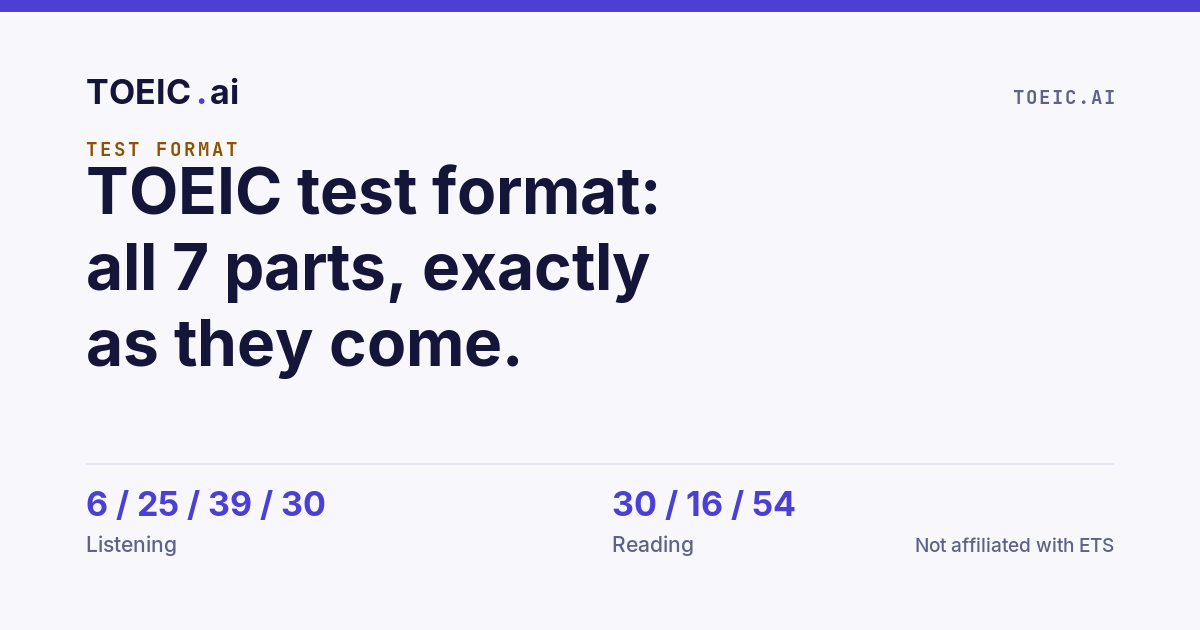
It comes after Part 1 Photographs and before Part 3 Conversations and Part 4 Talks. ETS builds the Listening section from 100 questions in about 45 minutes, and it reports your Listening result on the 5-495 scale.
Part 2 matters because it's the only Listening part where neither the questions nor the answer choices appear in your test book. Part 1 gives you a photo to look at, and Parts 3 and 4 print the questions and options. Part 2 gives you nothing to read, so it tests pure listening.
A quick note on the search phrase. "TOEIC Part 2" on this page means the Listening part of the Listening & Reading test. The Reading section starts at Part 5, and the TOEIC Speaking test numbers its tasks by question, so Speaking and Reading help lives elsewhere.
What Is the TOEIC Part 2 Test Format?
Part 2 has 25 questions, numbered 7 to 31. Each one is a spoken prompt followed by three spoken responses, (A), (B) and (C), played once, with a short pause to mark your answer before the next item starts.
One item runs the same way every time. You hear the item number, the prompt, then the three responses read one after another. The pause follows, and the next number begins. On your answer sheet that block sits at questions 7-31, straight after the six Part 1 photo items.
Your test book prints only the directions and the line telling you to mark your answer, so the three responses exist only as sound. ETS doesn't publish the exact pause length or a separate time for Part 2, so train yourself to treat it as a five-second pause and mark fast. Per the ETS Examinee Handbook, there's no penalty for guessing, so never leave a bubble blank.
The same eight facts hold for every Part 2 item.
| Feature | Part 2 detail |
|---|---|
| Number of questions | 25 |
| Question numbers | 7 to 31 |
| Answer choices per item | Three, (A) to (C), all spoken aloud |
| What is printed | Only the directions to mark your answer; no prompts or choices |
| Times the audio plays | Once |
| Pause between items | A short pause; ETS doesn't publish its exact length |
| Approximate total time | Not published per part; the full Listening section runs about 45 minutes |
| Penalty for wrong answers | None; ETS scores the number of correct answers |
What Are the Common TOEIC Part 2 Question Types?
Part 2 prompts fall into six families: Wh- questions, yes/no questions, tag questions, choice questions, statements, and requests and suggestions. The first two or three words tell you which one you're hearing.
The type matters because each one expects a different kind of reply. Once you know a "When" prompt needs a time, most wrong options fall away on their own.
Some patterns are less obvious. Yes/no questions and tag questions often get an indirect answer. "I'll have to check my calendar" is a typical one. Statements and requests contain no question at all, so the right reply is a natural follow-up or a confirmation. Choice questions such as "the 2 o'clock or the 4 o'clock?" accept "Either is fine" or a third option.
Read the table left to right: hear the opener, expect that reply, and reject that trap.
| Prompt type | Typical opener | What a correct reply supplies | Common wrong-reply trap |
|---|---|---|---|
| Who questions | "Who is...", "Who's going to..." | A person, job title or department, or a pointer to who would know | A place or a time, or a reply that repeats a prompt word |
| What and Which questions | "What time...", "Which file..." | The specific thing, choice or detail the prompt asks for, stated or implied | A reply that matches a prompt word but answers a different question |
| When questions | "When does...", "When will..." | A time, date or day, or a relative point such as "after lunch" | A place, such as "In the main conference room," offered instead of a time |
| Where questions | "Where is...", "Where can I..." | A place, a spot in the building, or a person who has the item | A time or a date, or a sound-alike of the place word |
| Why questions | "Why did...", "Why isn't..." | A reason, often starting with "because" or "to," or an implied cause | A reply that repeats the prompt's verb but gives no reason at all |
| How questions | "How long...", "How many...", "How did..." | A method, quantity, length or opinion that matches the word after "How" | A number for a "How did" prompt, or a manner for "How many" |
| Yes/no questions | "Do you...", "Is the...", "Have you..." | Yes or no with a detail, or an indirect reply that implies the answer | A yes or no that contradicts its own follow-up, or a word echo |
| Tag questions | "..., isn't it?", "..., didn't you?" | Agreement or disagreement with the statement, often with a short added fact | A reply about a related topic that ignores the statement being confirmed |
| Choice questions | "...the red one or the blue one?" | One option, "Either is fine," or a third option the speaker hadn't offered | A plain yes or no, which can't answer an either-or question |
| Statements | "The printer's jammed again." | A natural follow-up, such as a reaction, a suggestion or a question back | A reply that reuses a prompt word but makes no sense as a reaction |
| Requests and suggestions | "Could you...", "Why don't we..." | Acceptance, refusal with a reason, or an offer or question that moves things forward | A reply that treats "Why don't we" as a real Why question asking for a reason |
What Does a TOEIC Part 2 Question Look Like?
You hear one short line, for example "When does the quarterly meeting start?" and then three replies. They are (A) "In the main conference room," (B) "I haven't seen the agenda yet," and (C) "Yes, it started well." Only (B) works, because it tells you the speaker doesn't know the time yet.
Read every sample question the same way. Name the prompt type first, say why the correct answer fits, then name the trap each distractor uses. Choice (A) answers Where, and (C) gives a yes to a Wh- question.
The items here are original, written in TOEIC style rather than copied from ETS. Treat each one as a transcript you read only after you've tried it by ear. One shows an indirect response, and one shows a correct reply that asks a question back.
Four original items cover the patterns you'll meet most often.
- A When question with an indirect correct reply. "When will the new laptops arrive?" (A) "From the supplier in Osaka." (B) "Purchasing hasn't confirmed the order." (C) "Yes, they're the latest model." Answer: (B). It implies no date is set yet; (A) answers a Where question, and (C) says yes to a Wh- question.
- A yes/no question answered without yes or no. "Did you send the contract to Ms. Park?" (A) "It's in her inbox now." (B) "A three-year contract." (C) "The park closes at six." Answer: (A). It confirms the sending without saying yes; (B) repeats "contract," and (C) plays on "Park."
- A statement that needs a follow-up remark. "The projector in Room 4 isn't working." (A) "I'll call the IT desk." (B) "We have four projects this quarter." (C) "Yes, I'm working late tonight." Answer: (A). It offers a fix; (B) uses sound-alikes for "projector" and "4," and (C) echoes "working."
- A request answered with an offer or a question. "Could you review my slides before the meeting?" (A) "Sure, can you email them to me?" (B) "The meeting room on the third floor." (C) "I reviewed the hotel online." Answer: (A). It agrees and asks a question back; (B) repeats "meeting," and (C) echoes "review."
What Topics Come Up in TOEIC Part 2?
Part 2 prompts come from everyday workplace and daily-life situations: office tasks, scheduling, jobs, travel, banking, entertainment, dining and hotels.
Knowing a setting's vocabulary lets you predict likely replies and catch indirect ones faster. If you know what happens at a hotel front desk, "I'll check the reservation system" sounds like an obvious answer to a checkout question.
TOEIC doesn't require specialist business knowledge. The ETS Examinee Handbook lists the settings the whole test draws on, including general business, offices, personnel, finance and budgeting, dining out, entertainment, travel and housing. Business tasks, travel and transportation, banking, dining out and hotels all fit inside that list. Build your workplace vocabulary by topic with the TOEIC vocabulary lists, one setting at a time.
These seven settings recur across Part 2 prompts, each shown with two typical openers.
- Business tasks and meetings: "Who's taking notes at today's meeting?" or "Has the budget report been approved yet?"
- Jobs and occupations: "When does the new sales manager start?" or "Are you applying for the design position?"
- Travel and transportation: "Which gate does the Boston flight leave from?" or "Should we take a taxi to the airport?"
- Banking and finance: "Where do I deposit this check?" or "Why was the invoice paid twice this month?"
- Sports and entertainment: "Did you get tickets for Saturday's concert?" or "How long does the game usually last?"
- Dining out: "Would you like a table by the window?" or "Who's booking the restaurant for Friday night?"
- Hotels and accommodation: "What time is checkout at this hotel?" or "Is breakfast included with the room rate?"
What Are the Common Traps in TOEIC Part 2?
Most wrong Part 2 replies repeat a word from the prompt, use a word that sounds like one in the prompt, or answer a Wh- question with yes or no.
These distractors work because you anchor on a word you recognize instead of the meaning of the whole prompt. Word overlap feels like a match, and homophones and other sound traps feel like a match too, so a tired ear grabs them.
The reverse mistake costs points as well. You reject a correct indirect response because it holds no time, place or name. If you're working in the 600-800 band, these patterns are where to focus your Part 2 review, because the vocabulary is rarely what stops you. General test errors outside Part 2 belong on the TOEIC mistakes page.
Each trap targets a different listening habit, and each comes with a short example.
- Word-overlap distractors: "Where's the staff meeting?" answered with "The staff is very friendly." The same word appears, but the reply names no place.
- Sound-alike words and homophones: "Did you copy the report?" answered with "Coffee's in the kitchen." Copy and coffee sound close enough to pull a distracted listener.
- Yes/no replies to Wh- questions: "Why was the shipment late?" answered with "Yes, it was." A Wh- question never takes a plain yes or no, so cross it out.
- Wrong question-word match (a place for a When question): "When is the training?" answered with "In Room 12." That reply fits a Where question, not a When question.
- Related-word association: "Has the flight been delayed?" answered with "I'll pack my suitcase tonight." Flight and suitcase belong together, yet the reply ignores the question.
- Rejecting the indirect correct reply: "When's the deadline?" answered with "Ask Ms. Lee, she set it." People skip it because it has no date, yet it's correct.
What Are the Best Tips for TOEIC Part 2?
Lock onto the first two or three words, expect indirect answers, cross out replies that echo the prompt, and mark your answer within the pause, then move on.
The tips work as one routine inside the five-second pause rhythm of each item. The first words give you the question word, and the question word sets your expectation. Elimination does the rest: with three choices, dropping one wrong reply already leaves you at 50/50.
Guessing beats leaving a blank, since ETS doesn't penalize wrong answers. Use the pause to reset for the next item, not to replay the last one in your head.
Strong listeners run the same six-step routine on all 25 items.
- Catch the first two or three words. The question word, or the helping verb in a yes/no question, tells you the reply type before anything else is said.
- Predict the reply type before the options play. A When prompt needs a time, or a reason there isn't one yet, so hold that expectation through all three options.
- Expect indirect and question-back answers. Replies like "Let me check" or "Didn't Tom send it?" are often correct, so judge each one by whether it moves the exchange forward.
- Cross out replies that echo the prompt. A reply that repeats a prompt word or a sound-alike is usually a distractor, so drop it and compare the other two.
- Answer inside the pause and move on. Mark the letter as soon as the third option ends, then clear your head before the next item number is read.
- Never leave an answer blank. ETS scores only correct answers and charges no penalty for guessing, so even a blind pick gives you a one-in-three chance.
Where Can You Practice TOEIC Part 2 Questions?
Start with official ETS sample questions, then move to timed mock tests that play the audio once, so your practice matches real test conditions.
toeic.ai's free mock tests give you 1 full and 1 mini marked Listening & Reading test on the free plan, plus unlimited unmarked timed practice papers. Good Part 2 practice has real-speed audio, no replay, three spoken choices and a five-second answer window. Any mock test that lets you pause or rewind trains a habit the real exam won't allow.
A free TOEIC Part 2 PDF with an answer key is still useful for its transcript and vocabulary. Reading a transcript isn't listening practice, though. When you review a missed item, the cause usually shows up in the transcript within seconds: a repeated word, a sound-alike, or a correct indirect reply you skipped. Name the prompt type and the trap from the opener-to-reply table, and your timed practice gets sharper each round. To build those drills into a plan, see how to improve your TOEIC Listening score.
Are There Free TOEIC Part 2 Practice Tests?
Yes, free TOEIC Part 2 practice is available from ETS sample tests and from free full-length mock tests that include all 25 Part 2 items.
On toeic.ai, the free plan includes marked full and mini Listening & Reading mock tests, plus unlimited unmarked timed practice papers. You can start a TOEIC practice test without a card. Use the ETS sample test to learn the directions, then a free practice test to hear all 25 items in sequence. A free PDF set only helps if you play its audio; never turn it into a reading exercise.
Can You Listen to TOEIC Part 2 Audio a Second Time?
No, each Part 2 prompt and its three responses play only once, and the test moves to the next item after a short pause.
That rule shapes how you train. Because everything is played once, your practice should run with no replay too, or you'll build a habit the test punishes. ETS doesn't penalize wrong answers, so pick your best guess and move on. The same single-play rule covers the whole TOEIC Listening section, from Part 1 to Part 4.
How Many Parts Are There in the TOEIC Exam?
The TOEIC Listening & Reading test has seven parts: four in Listening (Photographs, Question-Response, Conversations, Talks) and three in Reading (Incomplete Sentences, Text Completion, Reading Comprehension).
Part 2 sits second in the Listening section, before the Reading section's three parts begin at Part 5. The TOEIC Speaking & Writing test is a separate exam with its own tasks. The full TOEIC test format sets out every part, and the natural next step after this page is Part 3 Conversations, where the questions and options do appear in your test book.
Is the TOEIC Exam Difficult to Pass?
No, there is no pass or fail on the TOEIC Listening & Reading test; you receive a score from 10 to 990, and each school or employer sets the score it needs.
ETS sets no pass mark, so the 10-990 scale only tells you where you stand. Many test-takers see Part 2 as one of the faster ways to lift a Listening score, because its 25 items are short and follow repeatable patterns. For what different totals mean against score requirements, see the TOEIC score guide.
Common Questions
What is TOEIC Listening Part 2?
Part 2 is Question-Response, the second of four parts in the TOEIC Listening section. You hear a question or statement followed by three spoken responses and choose the best one. Nothing is printed in the test book.
What is the TOEIC Part 2 test format?
Part 2 has 25 questions, numbered 7 to 31. Each is a spoken prompt followed by three spoken responses, (A), (B) and (C), played once, with a short pause to mark your answer. There is no penalty for wrong answers.
What are the common traps in TOEIC Part 2?
Most wrong replies repeat a word from the prompt, use a word that sounds like one in the prompt, or answer a Wh- question with yes or no. Test-takers also reject correct indirect replies that contain no time, place or name.
Can you listen to TOEIC Part 2 audio a second time?
No. Each Part 2 prompt and its three responses play only once, and the test moves to the next item after a short pause.
Is the TOEIC exam difficult to pass?
There is no pass or fail on the TOEIC Listening & Reading test. You receive a score from 10 to 990, and each school or employer sets the score it needs.