Test format
TOEIC Format: 7 Parts, 200 Questions in 120 Minutes
The TOEIC Listening and Reading test is 200 multiple-choice questions in 120 minutes: 100 Listening questions in about 45 minutes, then 100 Reading in 75. Nothing about that shape moves between sittings, which is what makes the clock plannable.
Share of the 200 questions
Bars are relative to the largest part; percentages are share of the whole test.
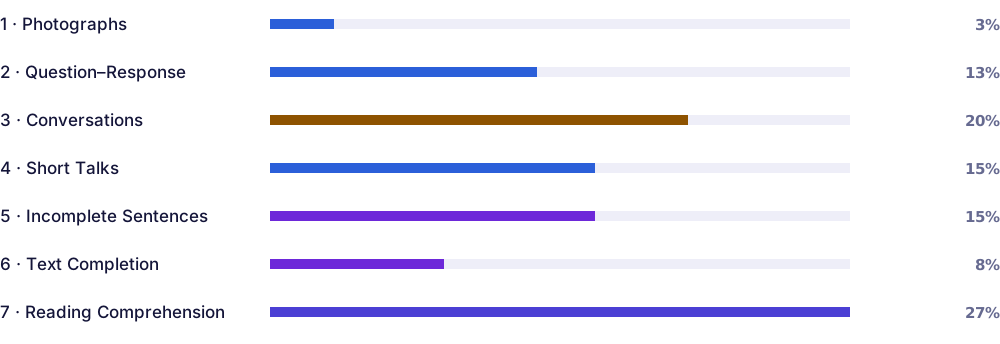
- Listening 6 / 25 / 39 / 30
- Reading 30 / 16 / 54
- Part 7 alone 54 questions
Parts 3 and 7 together are almost half the test, which is why splitting study time evenly across seven parts is the wrong split.
✓ Matches the current 7-part format · last reviewed July 26, 2026
The Whole TOEIC Listening and Reading Format on One Screen
The test is often shortened to TOEIC L&R, which separates it from the Speaking and Writing test ETS administers separately. The counts do not vary between test dates: 6, 25, 39, 30 in Listening, then 30, 16, 54 in Reading. Most sites publish this as read-only reference. Every row here links straight into practice.
| Part | The task | What it really measures | Qs | |
|---|---|---|---|---|
| Listening · ~45 min 1 · Photographs | Hear four statements, pick the one describing the photo | Concrete workplace vocabulary and the present continuous | 6 | Practice |
| Listening 2 · Question–Response | Hear a question, pick the best of three spoken replies | Question forms, and recognizing indirect answers | 25 | Practice |
| Listening 3 · Conversations | Three questions per two- or three-speaker dialogue | Holding several voices in memory on one hearing | 39 | Practice |
| Listening 4 · Short Talks | Three questions per monologue | Announcements, voicemails and briefings at natural speed | 30 | Practice |
| Reading · 75 min 5 · Incomplete Sentences | Fill one blank in a single sentence, four options | Grammar and word form, decided in about 20 seconds | 30 | Practice |
| Reading 6 · Text Completion | Fill four blanks in a short text, one of them a whole sentence | Cohesion across sentences, not just local grammar | 16 | Practice |
| Reading 7 · Reading Comprehension | Single, double and triple passage sets | Scanning speed and cross-referencing under time pressure | 54 | Practice |
Every answer is worth one point and nothing is deducted for a wrong one, so a blank is always worse than a guess. For who requires the test and why, see the.
TOEIC Listening Format: Parts 1–4, 100 Questions in ~45 Minutes
Listening is paced for you. Every recording plays once, the gap before the next item is fixed, and you cannot go back. The audio rotates across North American, British, Canadian, Australian and New Zealand voices, so anyone who has practiced with one accent only loses points that have nothing to do with vocabulary.
Part 1, Photographs (6 Questions)
You look at a photo and hear four statements; one describes it. Distractors work by sound rather than sense: a photo of a man writing attracts a statement about riding. Six questions is 3% of the test, so it is the wrong place to spend a week, but the easiest part to take to 100%.
Part 2, Question–Response (25 Questions)
You hear a short question and three possible replies, with nothing printed. No reading makes this the purest listening task on the test. People lose points because the correct reply is often indirect: "When will the report be ready?" is answered by "Maria is still waiting on the figures", not by a time.
Part 3, Conversations (39 Questions)
Thirteen short dialogues, three questions each. Some have three speakers, and some pair the audio with a chart, schedule or floor plan you must combine with what you hear. At 39 questions it is the largest Listening part, and it rewards reading the three printed questions in the pause before the audio starts.
Part 4, Short Talks (30 Questions)
Ten monologues, three questions each: recorded announcements, voicemails, tour commentaries, bulletins and staff briefings. Denser than Part 3, because no second speaker restates anything. Expect a question per set on implied meaning or the speaker's purpose rather than a stated fact.
TOEIC Reading Format: Parts 5–7, 100 Questions in 75 Minutes
Reading is self-paced inside one 75-minute block. Nobody stops you spending eight minutes on a single sentence, which is the danger. The average is 45 seconds per question, and the questions are not equally expensive.
Part 5, Incomplete Sentences (30 Questions)
One blank, one sentence, four options. Roughly half of Part 5 turns on word form and part of speech, much of the rest on prepositions, tense and connectors. A reliable shortcut: look at what follows the blank. A noun phrase needs a preposition; a subject plus verb needs a conjunction. The cheapest 30 points on the test, each decidable in under 20 seconds.
Part 6, Text Completion (16 Questions)
Four short texts, four blanks each. Three blanks per text behave like Part 5; one asks you to insert a complete sentence in the right place. The answer often depends on a sentence you have already read, a tense set two lines earlier, or a pronoun needing an antecedent. Reading only the sentence containing the blank loses these.
Part 7, Reading Comprehension (54 Questions)
The biggest part by a wide margin. Single passages account for 29 of the 54 questions: emails, notices, adverts, text-message chains, online chat threads, articles and forms. The other 25 come from multiple-passage sets, two double and three triple, where at least one answer per set only exists once you combine two documents, such as an email mentioning "the earlier rate" plus the price list showing it. Question types include vocabulary in context, "what is NOT stated", and sentence insertion. Part 7 is lost on the clock more often than on comprehension.
TOEIC Reading Time Management: A Pacing Plan for 75 Minutes
Listening sets your pace. Reading does not, so decide it in advance. Our TOEIC reading speed guide turns that budget into a reading pace. Working budgets, not rules, the point is to reach Part 7 with the clock intact.
| Reading part | Target budget | Per question | Qs | |
|---|---|---|---|---|
| 5 · Incomplete Sentences | 10–12 min | ~20–24 sec | 30 | Practice Part 5 |
| 6 · Text Completion | 8–10 min | ~35 sec | 16 | Practice Part 6 |
| 7 · Reading Comprehension | 53–57 min | ~60 sec | 54 | Practice Part 7 |
Check the Clock Twice
End of Part 5, end of Part 6. Two glances tell you whether Part 7 is safe.
Mark, Guess, Move On
An unsolved Part 5 item costs the same one point as a Part 7 item you never reach.
Use the Listening Pauses
Spend each gap reading the next set of printed questions rather than reviewing the last one.
How the TOEIC Format Turns Into a 990 Score
Each section produces a raw score out of 100, which ETS converts to a scaled score from 5 to 495; add the two for a total from 10 to 990 in five-point increments. The format is fixed, so the arithmetic is identical for everyone, and the last step is the part ETS does not publish.
There is no pass or fail, and no part is worth more per question: a Part 1 item and a Part 7 item are both one point.
The conversion uses an unpublished equating table specific to your test form. It keeps a 720 in March comparable to a 720 in October, and it means no third party can convert a raw score exactly. Treat any projected total, ours included, as a band of 20 to 30 points. Scores are valid for two years, per ETS. The TOEIC score guide has the country thresholds.
What Our TOEIC Practice Test Reproduces, and What It Can't
Our tests copy the format exactly: 200 questions, seven parts, the same counts, the same clock. What they cannot copy is a real ETS form. The bank holds 6,787 items, 3,099 Listening and 3,688 Reading, written in ETS style by our team and tagged by part, skill and difficulty.
Structure checked July 26, 2026. Tell us if anything has changed →
Straight About the Limits
- Not official ETS papers. Retired forms are published by ETS alone. Our items match the published format, question types and difficulty spread; they are not the real thing.
- Not every item carries a written explanation. You always see the correct answer on submit, and most items add a written rationale on review; a few are still key-only.
- Speaking and Writing is a separate track, marked by AI. Real mock tests and practice, but the band scores are our examiner’s judgment, not ETS’s.
- Projected scores are estimates. With the equating table unpublished, we label the number as a range.
Questions About the TOEIC Test Format
How many parts does the TOEIC test have?
Seven. Parts 1 to 4 form the Listening section with 6, 25, 39 and 30 questions. Parts 5 to 7 form the Reading section with 30, 16 and 54 questions. That is 100 per section and 200 in total.
How long is each section of the TOEIC test?
Listening runs about 45 minutes and is paced by the audio. Reading is a self-paced 75 minutes for 100 questions, roughly 45 seconds each. Total test time is 120 minutes, before registration and answer-sheet admin at the center.
Which TOEIC part is the hardest?
By points at risk, Part 7: 54 questions, 27% of the test, arriving last in a section where the clock is already spent. By pure listening difficulty, Part 2, because nothing is printed and the reply is often indirect.
Is there a penalty for wrong answers on the TOEIC?
No. One point per correct answer, nothing deducted for an incorrect one. Never leave a blank: on a four-option item a guess is worth 25% and a blank is worth zero.
Can I go back and change answers in the Listening section?
The audio controls the timing, so you answer as you go. Going back means missing the item currently playing, trading one uncertain answer for one guaranteed loss. Reading is different: within the 75 minutes you can move freely between Parts 5, 6 and 7.
What accents are used in the TOEIC Listening section?
North American, British, Canadian, Australian and New Zealand voices, rotated through the section. Prepare with one accent only and you lose points in Parts 3 and 4, where one unfamiliar vowel costs a whole three-question set.
Does the TOEIC test format ever change?
Rarely, and not without notice from ETS. The seven-part structure with these counts has been stable since the last major revision. We check this page against the published structure and stamp the review date above.
Take a Free TOEIC Practice Test in This Format
Take all seven parts under the real 120-minute clock and find out which of them is actually costing you points.
Free account, no credit card. Both TOEIC exams are covered.