TOEIC Reading Speed: WPM Needed, Pacing, Tips and Score
Overview
The Reading section of the TOEIC Listening & Reading test gives you 75 minutes for 100 questions, so your pace in words per minute decides how many you reach. Time management matters most in Part 7.
Reading speed on this test comes down to eight pieces.
What Reading Speed Do You Need for the TOEIC?
Most test-prep guidance puts the working target at about 150-200 words per minute with good comprehension; that pace lets a candidate reach every question in the 75-minute Reading section with a few minutes to spare. Treat 150-200 WPM as a coaching benchmark, not an ETS requirement. ETS publishes the time limit and the question count, never a reading speed.
Comprehension matters more than raw speed. TOEIC questions ask for specific details, inferences and links between texts, so a fast skim that misses the detail still costs you the point.
The load also climbs through the section. Part 5 gives you single sentences, Part 6 gives you short texts, and Part 7 moves from single passages to sets of multiple passages. Part 7 therefore sets the pace you need.
What Does the TOEIC Reading Section Specifically Test?
The Reading section tests how quickly and accurately you understand written workplace English. It covers grammar and vocabulary in Part 5, meaning across sentences in Part 6, and detail, inference and cross-text links in Part 7. ETS's examinee handbook says you answer all 100 questions at your own pace, so pacing is entirely yours to manage.
Each part asks for a different kind of reading, and the load grows from one part to the next.
| Part | Name | Questions | What you read | Reading skill tested |
|---|---|---|---|---|
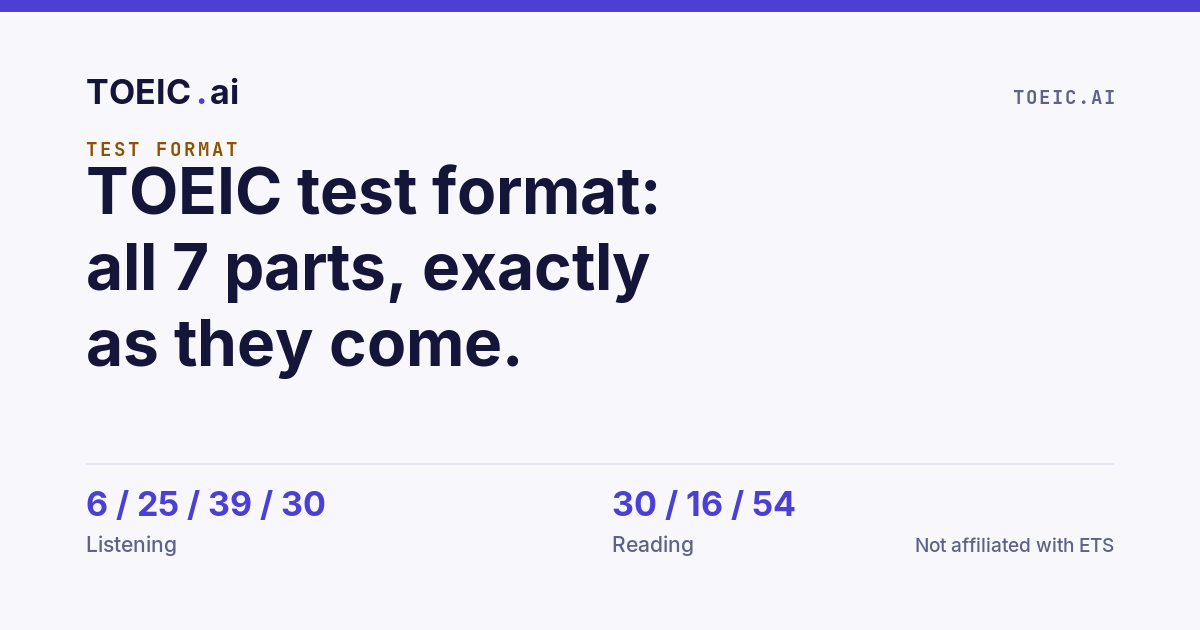
| Part 5 | Incomplete Sentences | 30 | Single sentences, each with one gap | Grammar and vocabulary in context |
| Part 6 | Text Completion | 16 | Short texts such as e-mails and notices, with gaps | Meaning across sentences |
| Part 7 | Reading Comprehension | 54 | 29 questions on single passages, 25 on multiple passages (double or triple sets) | Detail, inference and cross-text links |
What Is the Recommended Time Breakdown per TOEIC Reading Part?
A common plan is about 20 minutes for Parts 5 and 6 together (roughly 30 seconds or less per question) and about 55 minutes for Part 7 (roughly one minute per question on average). Start from the official numbers: ETS sets 100 questions in 75 minutes. Part 5 and Part 6 hold 46 questions, so 20 minutes gives you about 26 seconds each. The 54 Part 7 questions then share the remaining 55 minutes, about 61 seconds each.
The section-level TOEIC reading time table sits on our Reading guide; this page turns it into a pace.
The minutes follow the question counts, so you can shift this time budget toward your weaker part.
| Part | Questions | Suggested minutes | Seconds per question | Move-on cue |
|---|---|---|---|---|
| Part 5 | 30 | About 11-12 | About 20-25 | The gap is still unclear after one look at the options |
| Part 6 | 16 | About 8 | About 30 | You are rereading the whole text for a single gap |
| Part 7 | 54 | About 55 | About 61 on average: about 50 for single passages, about 75 for multiple passages | You have scanned the passage twice without finding the answer |
How Do You Take a TOEIC Reading Speed Test at Home?
A home reading speed test measures your words per minute on real TOEIC-style text and checks that comprehension holds at that pace. The free ETS sample test gives you official passages to time.
Five steps turn one Part 7 passage into a number you can track.
- Pick an official ETS sample Part 7 passage, ideally one you have not read before, from the free sample test on the ETS site.
- Count or look up its word count; pasting the text into any word counter takes well under a minute.
- Time yourself reading it once, without rereading, and stop the clock the moment you reach the final line.
- Divide words by minutes to get WPM: a 300-word passage read in 1.5 minutes works out to 200 words per minute.
- Answer its questions to check comprehension, and treat any wrong answer as a sign that your pace is running ahead of you.
Repeat the check every week or two on fresh passages and compare the result against the 150-200 WPM benchmark. A high number with wrong answers means slow down, because the comprehension check counts for more than the speed figure.
Is Reading 400 WPM Fast Enough for the TOEIC?
Yes, 400 WPM is far faster than the TOEIC requires, but only if comprehension holds at that pace.
Marc Brysbaert's 2019 review of 190 reading studies put the average adult silent reading rate in English at about 238 words per minute, so 400 WPM is already fast. Is reading 700 WPM good? At 700 WPM you are in speed reading territory, and understanding usually drops. How fast is 1000 WPM reading? Claims of 1000 WPM usually describe skimming, with low recall of the details.
Chasing those numbers won't help on the TOEIC. Part 7 questions test specific details and cross-references between texts, so you need accurate reading at a steady pace, not maximum speed.
What Are the Top Tips to Boost Your TOEIC Reading Speed?
Reading speed on the TOEIC improves through habits that cut wasted eye movement and wasted rereading, not through rushing. Seven habits raise your pace without costing accuracy.
- Read the questions before the passage. You then read with a purpose and can stop once you have found the detail each question asks for.
- Stop subvocalizing. Subvocalization, saying each word silently in your head, holds you near speaking speed; pacing your eyes with a pen helps break it.
- Avoid back-reading. Back-reading, jumping back to a line you already finished, eats seconds on every passage, so push on and let context fill the gap.
- Skim for structure, then scan for keywords. Skimming and scanning work as a pair: skim the layout first, then scan for the names, dates and numbers the question uses.
- Read in phrases, not single words. Take in a group such as "by the end of the month" as one unit, which cuts the eye stops per line.
- Build business vocabulary. Unknown words are the main cause of rereading, so learning the business vocabulary of invoices, schedules and memos removes those stalls before test day.
- Practice with a timer every session. Timed practice teaches you what 26 seconds per question actually feels like, something untimed study never does.
How Should You Manage Your Time When a Question Slows You Down?
Set a cut-off, pick your best guess when you hit it, flag the question and move on. A common rule is about 45 seconds for a Part 5 or Part 6 question and about 90 seconds for a Part 7 question.
Guessing is the right call: ETS states there is no penalty for guessing, so an educated guess always beats a blank. When flagging questions, mark a guess on the answer sheet at once and revisit only if time allows.
Check your watch twice: at the end of Part 6 and halfway through Part 7, against the time budget table above. Keep your cut-off time strict and save the last two minutes to fill any answers still empty. For repeated stalls, the longer-term fixes that improve your Reading score are vocabulary and grammar.
How Does Reading Speed Affect Your TOEIC Score?
Speed affects your score mainly through questions you never reach. Each unanswered Reading question is a lost raw score point, and ETS converts the number you answer correctly into a scaled score on the 5-495 Reading scale.
Slow readers often lose most of their points at the end of Part 7, where the multiple-passage sets sit. A common timed-mock pattern is a candidate who spends 15 minutes on Part 5, then leaves the final triple-passage set as unanswered questions or blind guesses.
Speed only pays off when accuracy holds, which is why the home test pairs every WPM figure with a comprehension check.
Is an 810 TOEIC Score Considered Good?
Yes, 810 is a strong TOEIC score; it sits above the 785 total often linked to the B2 level, and reaching it usually means finishing the Reading section.
That 785 points figure is the sum of ETS's B2 minimums, 400 for Listening and 385 for Reading. An 810 TOEIC score needs a Reading score well above the 250 midpoint of the scale, which is hard to reach with unanswered Part 7 questions. See our TOEIC 800 score guide for the plan.
Does the TOEIC Listening and Reading Test Penalize Wrong Answers?
No, the TOEIC Listening and Reading test does not penalize wrong answers; only correct answers count toward the score.
ETS's TOEIC Listening & Reading handbook says the number of correct answers in each section converts to a scaled score, with nothing taken off for wrong answers. For pacing, the consequence is simple: answer every question, even with a guess, before time runs out. Our TOEIC score guide explains the full scale.
How Fast Should You Work Through TOEIC Reading Passages in Part 7?
The Part 7 pace averages about one minute per question: roughly 50 seconds for single passages and about 75 seconds for double and triple passage sets. With 29 questions on single passages and 25 on double passages and triple passages, that split fits the 55 minutes. Read the questions first on the multiple sets, because cross-reference questions combine facts from two texts. Our TOEIC Part 7 guide breaks down each passage type.
Is There a Free TOEIC Reading Practice Test Online?
Yes, free online TOEIC Reading practice exists, including ETS's official sample questions and free full-length practice tests.
On toeic.ai, the free plan includes fully marked mock tests in Listening & Reading, one full-length test and one mini, plus unlimited unmarked timed practice papers. A Reading Only paper runs 100 questions in 75 minutes, so you can rehearse the real pace. Take a free practice test from our TOEIC practice test page and compare your timing with the budget above.
Common Questions
What reading speed do you need for the TOEIC?
Most test-prep guidance puts the working target at about 150-200 words per minute with good comprehension. That is a coaching benchmark, not an ETS figure; ETS sets 100 Reading questions in 75 minutes.
What is the recommended time breakdown per TOEIC Reading part?
A common plan is about 20 minutes for Parts 5 and 6 together, about 26 seconds per question, and about 55 minutes for the 54 Part 7 questions, about 61 seconds per question on average.
Is reading 400 WPM fast enough for the TOEIC?
Yes. 400 WPM is far faster than the TOEIC requires, but only if comprehension holds at that pace, because Part 7 questions test specific details and cross-references.
Does the TOEIC Listening and Reading test penalize wrong answers?
No. ETS states there is no penalty for wrong answers; only correct answers count, so answer every question before time runs out.
How fast should you work through TOEIC Reading passages in Part 7?
About one minute per question on average: roughly 50 seconds for single passages and about 75 seconds for double and triple passage sets, which fits the 55 minutes left for Part 7.