TOEIC Part 6: Format, Question Types, Timing, Tips, Practice
Overview
TOEIC Part 6 hands you four short business texts, each with four blanks. ETS places this Text Completion task second in the Reading section of the TOEIC Listening & Reading test, between Part 5 and Part 7. Seven topics shape it.
What Is TOEIC Part 6?
TOEIC Part 6 is the Text Completion part of the TOEIC Listening & Reading test. Each of four short workplace texts has four blanks, and every blank offers four choices, (A) to (D). It's a multiple-choice task, so you pick rather than write.
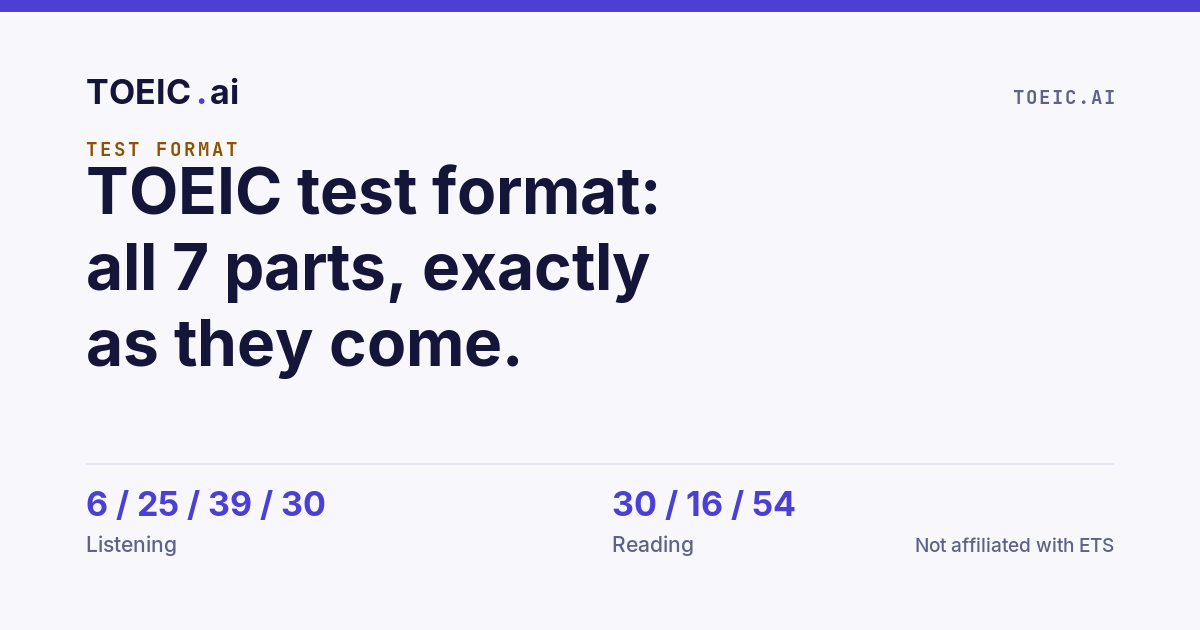
The Reading section holds three parts: Part 5 Incomplete Sentences, Part 6 Text Completion and Part 7 Reading Comprehension. Together they cover 100 questions in 75 minutes, and Part 6 is the shortest at 16 questions. Across the full TOEIC format there are seven parts, four in Listening and three in Reading.
Part 6 measures grammar and vocabulary, and it also checks whether you can follow meaning from one sentence to the next.
How Many Questions Are in TOEIC Part 6?
TOEIC Part 6 has 16 questions, numbered 131 to 146, spread across four texts with four blanks each. In each text, three blanks take a word or phrase and one takes a whole sentence. The part starts at question 131, straight after the last Part 5 item, and ends at question 146.
ETS numbers the Reading section 101 to 200, so Part 6 always lands in the same band of the answer sheet.
| Item | Part 6 figure |
|---|---|
| Total questions | 16 |
| Question numbers | 131-146 |
| Texts | 4 |
| Blanks per text | 4 |
| Word/phrase blanks per text | 3 |
| Sentence blanks per text | 1 |
| Share of Reading questions | 16 of 100 |
Every blank has four answer options, and ETS bases your score on correct answers only. Part 6 gets no separate score. Your correct answers feed the Reading scaled score of 5 to 495, along with Parts 5 and 7.
What Types of Passages Appear in TOEIC Part 6?
Part 6 uses short workplace documents written in a business register, usually one or two paragraphs long. Expect texts that could come from an ordinary office inbox or notice board.
- Emails: a customer email or a message between colleagues that requests action or confirms an order.
- Internal memos: an internal memo telling staff about a policy change, an office move or new procedures.
- Letters: a business letter that confirms an appointment, offers a position or answers a formal complaint.
- Announcements: news of a product launch, a staff appointment or a company event, addressed to readers.
- Notices: a notice on a board or website that sets out rules, opening hours and the dates they apply.
- Advertisements: an advertisement that promotes a service, a sale or a job opening and asks readers to respond.
The passage type tells you which words to expect. A customer email leans on apologies, refunds and delivery dates. A notice leans on times, rules and locations, so the blanks there often turn on a date or a preposition of place.
What Question Types Does TOEIC Part 6 Test?
Part 6 tests four kinds of word-level blank plus one sentence insertion per text: word form, verb tense and form, function words, and vocabulary in context. The answer choices usually tell you which kind you face.
- Word form (part of speech): four options built on one root, such as a noun, a verb, an adjective and an adverb, testing parts of speech.
- Verb tense and form: options that differ only in tense or voice, so verb tenses must match the time the text describes.
- Prepositions and conjunctions: short function words, such as prepositions like in, on or by and conjunctions like although or because, that join ideas.
- Connectors and transition words: phrases like however, as a result or at the same time that set the logic between two sentences.
- Pronouns and reference words: options like it, they, this or those, where the right one must point back to a named noun.
- Vocabulary in context and collocations: four words of the same form but different meaning, testing collocations such as meet a deadline or place an order.
- Sentence insertion: four complete sentences, all correct English, where only one continues the thought of the surrounding paragraph in the text.
Word-form, grammar and vocabulary blanks make up 12 of the 16 questions, or 75%. That's why lexical questions and collocations matter as much as grammar here.
The common advice to "read around the blank" works for some blank types and fails for others. This table shows how much of the text each type needs, with cues taken from the ETS official sample test (the Pak Designs training email, questions 131-134).
| Blank type | What it tests | Reading scope needed | Cue to look for |
|---|---|---|---|
| Word form | Part of speech | The sentence alone | Options share a root, like interest, interests, interested, interesting (sample question 131) |
| Vocabulary and collocation | Meaning and fixed word pairs | The sentence alone, sometimes the one before | Same-form words with different meanings, like develop, raise, open, complete (sample question 132) |
| Preposition or conjunction | Links inside one sentence | The sentence alone | Short function words in the options |
| Verb tense and form | Time and voice | The whole text | A date line, "next month", "last quarter" or a past event named earlier |
| Pronoun or reference word | What a word points back to | The previous one or two sentences | it, they, this or those in the options |
| Connector | Logic between sentences | The previous sentence | Phrases like After all, For, Even so, At the same time (sample question 133) |
| Sentence insertion | Coherence | The whole paragraph | Four full sentences as options (sample question 134) |
How Do Sentence-Insertion Questions Work in TOEIC Part 6?
In each Part 6 text, one blank asks you to choose the full sentence, out of four options, that fits the gap logically. The right sentence connects to the lines on both sides through a pronoun reference, a repeated idea or one of the transition words.
Grammar alone won't settle it. All four options are usually correct English, and only one acts as a logical bridge.
Check what the sentence before the blank sets up and what the sentence after it assumes. Reject options that start a new topic, refer to something not yet named ("this change" with no change mentioned) or contradict a detail. However and therefore signal the relationship.
The sentence insertion came with the updated TOEIC Listening & Reading test, which ETS first launched in May 2016. That update raised Part 6 from 12 to 16 questions.
How Is TOEIC Part 6 Different From Part 5?
Part 5 gives you 30 single sentences with one blank each, while Part 6 gives four connected texts where the right answer can depend on sentences before or after the blank. Part 6 also tests a sentence insertion, which Incomplete Sentences never has.
The grammar and vocabulary overlap heavily, so strong Part 5 grammar usually carries into Part 6. Part 6 adds one skill on top: it rewards readers who track context clues across a connected text.
That's where Part 6 catches people. A tense or pronoun that looks right in its single sentence can be wrong for the text as a whole.
How Much Time Should You Spend on TOEIC Part 6?
Aim for about 8 minutes, roughly two minutes per text. Stronger readers can target 6 to 7 minutes, and either way the goal is to protect time for Part 7.
Here's the time allocation. The Reading section gives you 75 minutes for 100 questions. A common split is 10 to 12 minutes for Part 5, about 8 for Part 6 and the remaining 55 or so for the 54 Part 7 questions, which need every minute saved here.
Good time management means a firm limit. If a blank takes more than about 30 seconds, mark your best guess and move on. ETS states there is no penalty for guessing, so never leave a blank empty.
How Do You Work Through a TOEIC Part 6 Text?
A fixed routine per text keeps Part 6 inside eight minutes and catches the blanks that depend on context. Run every text through the same five moves.
- Skim the first line or header to fix the text type, its purpose and any date line, since tense blanks later depend on it.
- Classify each blank by its answer options (word form, tense, connector, vocabulary or sentence) to decide how much text you need to read.
- Answer the sentence-level blanks first from the sentence alone, because word-form, preposition and collocation blanks rarely need anything wider than that.
- Answer tense and connector blanks next, checking the date for tense and the previous sentence for the logic of a connector.
- Answer the sentence-insertion blank last, reading both neighboring sentences and choosing the option that links them without adding a new topic.
Step 2 is where the blank-type table pays off. Once you know a blank needs only its sentence, you stop reading the whole text for it.
What Are the Common Traps in TOEIC Part 6?
Most Part 6 traps are options that are correct in isolation but wrong for the text, or words that look alike. These distractors are built to catch a hurried reader.
- Look-alike words with different meanings: economic and economical look close, but "an economical car" means cheap to run, so "an economic car" is wrong.
- Relative pronouns (who, which, whose, that): choosing "which" for a person, as in "the manager which approved it", is the classic wrong pick.
- Adjectives vs participles (-ing vs -ed): "interesting employees" describes staff others find interesting, while the sample text needs "interested employees" who want training.
- A tense that fits the sentence but not the text's date: "will open" reads fine alone, but tense consistency fails when the email is dated after the opening.
- A connector that reverses the intended logic: "However" before a sentence that agrees with the previous one is grammatical but wrecks the meaning.
- A sentence-insertion option that names something not yet introduced: "These changes take effect Monday" is wrong when no changes were mentioned before the gap.
The ETS sample builds the participle trap in directly: question 131 offers both interested and interesting, and both sound natural on a quick pass.
What Are the Best Tips for a High Score in TOEIC Part 6?
High scores in Part 6 come from grammar and vocabulary built for business texts, plus practice reading whole short texts. The habits worth building before test day are listed here in order of payoff. For the whole section, see how to improve your TOEIC Reading score.
- Do not read the whole passage word by word before answering; skim for text type and date, then read only as far as each blank needs.
- Pay attention to lexical questions, the largest share of Part 6, by studying words in the business contexts where they usually appear.
- Master basic grammar, especially tenses, word forms and relative clauses, because they decide most of the non-vocabulary blanks in each text.
- Learn business collocations such as meet a deadline, place an order and submit a report, since Part 6 tests the pair, not the word.
- Build a list of transition words by function, grouping contrast, result and addition, so connector blanks become a quick lookup.
- Review every mistake by blank type, not just by score; that kind of error review shows which family of question costs you points.
Where Can You Practice TOEIC Part 6?
Part 6 practice comes in official ETS sample questions, free PDF sets and full-length practice tests that place Part 6 inside the timed Reading section. Only a full-length test makes Part 6 timing realistic, because the time pressure comes from Part 7 waiting afterwards.
Whatever you use, check the answer key and log each miss by blank type, using the table above. After two or three tests, that log shows exactly which family of question costs you the most points.
Is There a Free TOEIC Part 6 Practice Test?
Yes, free Part 6 practice exists in two forms: ETS's official sample questions and free full-length practice tests that include Part 6. The toeic.ai free plan includes one marked mock test, a full-length test of Listening & Reading covering all seven parts, so you practice Part 6 under real timing. You can also sit unlimited unmarked timed papers. The free practice test lives on our TOEIC practice test page.
Are TOEIC Part 6 Practice Tests Available as a PDF?
Yes, Part 6 practice sets are widely shared as PDFs, and ETS publishes official sample questions you can print. PDF practice sets suit untimed practice on single blank types, but they can't reproduce the time pressure of the full Reading section. Unofficial PDFs vary in quality, so prefer sets that follow the current format of 16 questions in four texts. Our TOEIC preparation guide shows where PDFs fit in a study plan.
Where Can You Find TOEIC Reading Part 6 Questions With Answers?
The most reliable Part 6 questions with answers are ETS's official sample questions and practice tests that mark your Reading section. The answer key alone teaches little. Note why each of the wrong options fails: wrong form, wrong tense for the text or wrong logic. Our overview of the TOEIC Reading section shows how Part 6 sits next to Parts 5 and 7.
Should You Practice TOEIC Part 5 and Part 6 Together?
Yes, practicing Part 5 and Part 6 together works because they test the same grammar and vocabulary, and the order matters: drill a blank type in Part 5 sentences first, then meet it inside Part 6 texts. A practical session pairs one Incomplete Sentences set of grammar drills with one Part 6 text, timed at 20 seconds per question and two minutes per text. Our TOEIC Part 5 guide covers the blank types in detail.
Common Questions
What is TOEIC Part 6?
Part 6 is the Text Completion part of the TOEIC Listening & Reading test. Four short workplace texts each have four blanks, and you choose the best of four options (A-D) for each.
How many questions are in TOEIC Part 6?
16 questions, numbered 131 to 146, across four texts with four blanks each. Three blanks per text take a word or phrase and one takes a whole sentence.
How is TOEIC Part 6 different from Part 5?
Part 5 has 30 single sentences with one blank each. Part 6 has four connected texts where the answer can depend on other sentences, and it adds a sentence-insertion question.
How much time should you spend on TOEIC Part 6?
About 8 minutes, roughly two minutes per text, or 6 to 7 minutes for stronger readers, so that enough of the 75-minute Reading section is left for Part 7.
Is there a free TOEIC Part 6 practice test?
Yes. ETS publishes official sample questions, and free full-length practice tests, such as the marked Listening & Reading mock on toeic.ai, include Part 6 under real timing.