TOEIC Parts of Speech Questions: Clues, Rules, Traps, Tips
Overview
ETS places TOEIC parts of speech questions in Part 5 (Incomplete Sentences) of the TOEIC Listening & Reading test, where four options share one root word.
The guide runs from spotting these items to answering them.
What Are TOEIC Parts of Speech Questions?
A parts of speech question, also called a word form question or word family question, is a Part 5 item whose four options share one root, such as decision, decide, decisive and decisively. Only one form fits the grammar of the sentence.
The options cover the four main parts of speech: noun, verb, adjective and adverb. Participles (-ing and -ed forms) appear as options too.
This type differs from the other Part 5 families. Vocabulary questions offer four different words with the same part of speech, while grammar questions test tense, pronouns, prepositions or conjunctions. If you've searched for a "TOEIC part of speech test," it isn't a separate exam. ETS sets these items inside the Reading section.
How Many Parts of Speech Questions Are in TOEIC Part 5?
Test-prep sources estimate roughly 7 to 10 of the 30 questions, about a quarter to a third of Part 5. ETS doesn't publish a breakdown by question type, so treat it as an estimate.
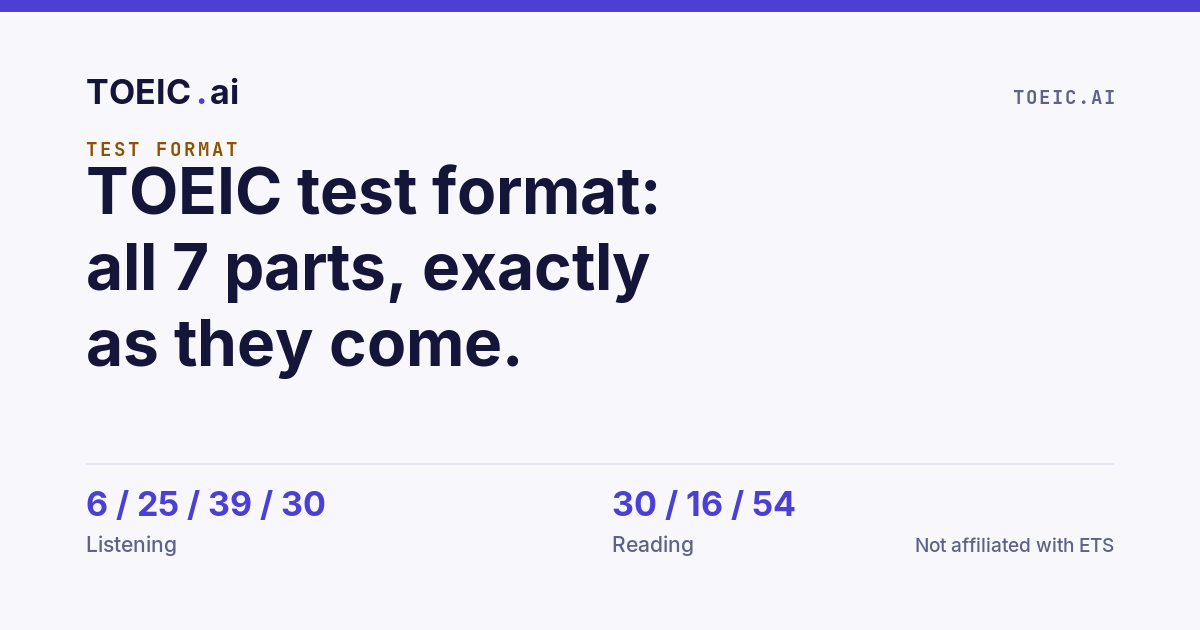
The frame around it is fixed. Part 5 holds 30 questions, questions 101-130 in the test book, inside a Reading section of 100 questions in 75 minutes. Word-form items are among the fastest points in that time.
The same skill comes back in Part 6 (Text Completion), where some blanks also ask for a word form. Part 5 carries no separate score; correct answers feed the Reading scaled score of 5 to 495.
How Do You Spot a Parts of Speech Question?
Read the four answer options before the sentence. If they share one root word and differ only in their word endings, you're looking at a parts of speech question, and the words right next to the blank decide it.
Four quick signals give the question away.
- All four options share one root, as in decision, decide, decisive and decisively, so the meaning stays constant.
- The endings differ (-ion, -e, -ive, -ly), which is the visible mark of a word form item.
- The answer depends on the word before or after the blank, usually an article, preposition or verb.
- The meaning of the sentence barely matters, because every option carries the same core idea of deciding.
You don't need to translate the sentence or read it end to end. The surrounding words, usually two on each side of the blank space, carry the grammar. Full reading is for vocabulary and grammar questions.
How Do Suffixes Tell You the Part of Speech?
Word endings are the fastest clue to the part of speech. The noun suffixes are -tion, -ment, -ance and -ness, and the verb suffixes are -ate, -ify, -ize and -en. The adjective suffixes include -ful, -ive, -ous, -able and -al, while -ly is the usual adverb suffix.
Each common ending lines up with a set of business words you'll meet in Part 5.
| Part of speech | Common suffixes | Example word family |
|---|---|---|
| Noun | -tion, -ment, -ance, -ness | production, development, performance, effectiveness |
| Verb | -ate, -ify, -ize, -en | evaluate, notify, finalize, strengthen |
| Adjective | -ful, -ive, -ous, -able, -al | successful, productive, various, reliable, financial |
| Adverb | -ly | successfully, productively, reliably, financially |
Several common business words break those patterns. Merriam-Webster and the Cambridge Dictionary list each one below under the part of speech shown in brackets.
| Suffix | Usually signals | Exception words | How to tell from the sentence |
|---|---|---|---|
| -ly | Adverb | friendly, costly, timely, likely (adjectives) | They sit before a noun or after be: "a timely reply," "the repair was costly." |
| -al | Adjective | proposal, approval, arrival, rental (nouns) | They follow an article or possessive: "the proposal," "our arrival." |
| -ive | Adjective | representative, executive, alternative (nouns) | They name a person or option after a or the: "a sales representative." |
| -ant / -ent | Adjective | applicant, assistant, consultant, resident (person nouns) | They name a person and take an article or a plural: "three applicants." |
| No -ly | Not an adverb | fast, hard, late, well (adverbs) | They follow the verb they modify: "work hard," "arrived late," "performed well." |
The suffix tells you what a word is, but only the position of the blank tells you what the sentence needs. When the two disagree, trust the position.
How Do You Use Each Part of Speech in a Sentence?
Each part of speech fills a small set of slots in a sentence, and knowing those slots answers most word-form items without translation.
Match the blank to the slot each form fills.
- Noun: after an article (a, an, the), a possessive (our, their) or a preposition, and as subject or object, as in "Our manager approved the proposal."
- Verb: after a subject, or after will, should, can, have or to, as in "The team will finalize the schedule by Friday."
- Adjective: before a noun, as in "a careful review," or after be, seem, become or remain, as in "The figures remain accurate."
- Adverb: before an adjective (extremely busy), before or after a verb, or at the start of a sentence, as in "Unfortunately, the shipment arrived damaged."
Be, seem, become and remain are linking verbs, which is why an adjective follows them. Four blank patterns recur often enough to learn by sight.
An article or possessive adjective, then an adjective, then a blank takes a noun: "their careful review of the contract."
Be, then a blank, then a past participle takes an adverb: "The report is carefully reviewed."
An auxiliary verb, then a blank, then a verb takes an adverb: "The company will soon announce a merger."
A blank between a preposition and a noun takes an adjective: "for additional information."
What Strategy Works for Word Form Questions?
A fixed four-step routine turns each item into a few seconds of pattern-matching.
Run every word-form item through the same four moves.
- Check the options: one root, different endings means a parts of speech item, so skip translating and go straight to the blank.
- Read only the words around the blank, usually two on each side, because they hold the grammar that decides the answer.
- Name the slot (noun, verb, adjective or adverb) using the position rules, before you look at a single option ending again.
- Pick the form with the matching suffix, then check singular/plural and person vs thing, since two nouns often compete for one slot.
Here's a worked example written for this article, not an official ETS item: "The manager made a quick ___ about the budget." The options are (A) decide, (B) decision, (C) decisive and (D) decisively.
The blank follows the article a and the adjective quick, so the slot is a noun, and decision is correct. The wrong options each fail for a reason the word-form strategy predicts.
Decide is a verb and can't follow an adjective. Decisive is an adjective, and two adjectives in a row leave the sentence with no object. Decisively is an adverb, and an adverb can't be the object of made. The singular and plural check passes too, since a needs a singular noun.
What Are the Common Traps in Parts of Speech Questions?
Most traps are two options with the same part of speech, or a form that looks right next to one word but breaks the sentence structure.
These distractors are written to catch a reader who stops at the suffix.
- Two nouns: a person and a thing (applicant vs application). "Please submit your applicant by Friday" fails, because person nouns name people, not documents.
- Present vs past participle as adjectives (interesting vs interested). "The staff were interesting in the course" is wrong; participle adjectives in -ed describe how people feel.
- A noun used as a modifier (safety regulations, sales figures). Choosing "safe regulations" misses compound nouns, where the first noun works like an adjective.
- An adjective after a linking verb, not an adverb (looks good, seems reasonable). "The offer seems reasonably" is wrong, because linking verbs take adjectives.
- Adverbs with a different meaning (hard vs hardly, late vs lately). "She worked hardly on the report" says she barely worked, the opposite of the intended sense.
- Singular noun that needs an article or a plural form. "We need consultant" fails, since countable nouns take a, the, or a plural such as consultants.
Words like costly and proposal, which look like the wrong part of speech, are covered in the suffix-exceptions table earlier on this page.
How Much Time Should You Spend on Parts of Speech Questions?
Aim for about 10 seconds per parts of speech question, well under the 20 to 25 seconds per item that keeps your total Part 5 time to 10-12 minutes. Both are common test-prep targets, not ETS rules.
ETS gives the Reading section 75 minutes for 100 questions, and every second saved on word-form items goes to Part 7, where 54 reading-comprehension questions wait.
If a word-form item isn't clear within about 15 seconds, it's probably a vocabulary or grammar question in disguise. Good time management means picking your best guess and moving on, because ETS states there is no penalty for guessing.
How Should You Study for TOEIC Parts of Speech Questions?
Study for these items pairs input, meaning word families and positions, with output: many timed questions and a review of every miss.
Six habits cover both halves.
- Learn business word families as sets of four (noun, verb, adjective, adverb), such as produce, production, productive and productively, rather than single words.
- Start with grammar input if word positions are new, since grammar basics like articles, auxiliaries and linking verbs make every later drill faster.
- Drill Part 5 questions in timed sets of 10 to 15, so the 10-second target becomes a habit before test day.
- Log every miss by trap type, not just by score, in an error log that shows whether participles or person nouns cost you most.
- Revisit the suffix-exceptions table weekly until words like timely, rental and representative stop looking like the wrong part of speech.
- Read short business texts and label word forms, building business vocabulary from memos, notices and job ads instead of word lists.
This is preparation work. The four-step routine from the strategy section stays the same on test day. Our guide on how to improve your TOEIC Reading score covers the rest of the section.
Where Can You Practice TOEIC Parts of Speech Questions?
Practice for this question type comes from ETS sample questions, free quiz and PDF sets, and full-length practice tests. In a practice test, the word-form items sit inside a timed Part 5.
A full-length test is the only way to rehearse the time pressure, because speed matters only when Part 7 is waiting. Whatever source you use, check that it follows the current Part 5 format: 30 single-sentence items with four options each. Unofficial sets vary in quality, so make sure yours comes with an answer key before you rely on it.
Where Can You Find TOEIC Parts of Speech Questions With Answers?
The most reliable parts of speech questions with answers are ETS's official sample questions and full-length practice tests that mark the Reading section. ETS's sample test ends with an answer key.
On toeic.ai, the free plan includes one full-length marked mock test for Listening & Reading and a marked mini mock, both with Part 5 under real timing. It also gives you unlimited unmarked timed practice papers. Start with a TOEIC practice test.
Is a Parts of Speech Quiz or PDF Enough to Prepare?
No, quiz cards and PDF sets help you learn word families, but they cannot train the speed and option-reading the timed test demands.
Flashcards and PDF sets vary in quality, and many mix in grammar that the TOEIC doesn't test. Use them for untimed drilling of word families. Then move to timed questions inside a full TOEIC preparation plan.
How Do Parts of Speech Questions Fit Into TOEIC Part 5?
The parts of speech questions are one of the main Part 5 question families, alongside vocabulary, grammar and connector questions.
A balanced TOEIC Part 5 plan trains all four families. The fast word-form items buy time for the slower vocabulary questions and grammar questions. Connector questions, which test words such as although and however, need the clauses on both sides of the blank.
Which 20 Examples of Parts of Speech Should You Practice First?
The 20 examples to practice first are the business word families that recur in Part 5, such as decide, produce, compete, rely and inform.
Expand each of these business roots into its four forms: decide, produce, compete, rely, inform, apply, expand, require, reserve, attend, succeed, consider, evaluate, assist, prefer, analyze, approve, depend, complete and innovate. Treat it as a study list, not ETS frequency data. Our TOEIC grammar guide covers the rules behind each slot.
Common Questions
What are TOEIC parts of speech questions?
They are Part 5 items whose four options share one root, such as decision, decide, decisive and decisively. Only one word form fits the grammar of the sentence.
How many parts of speech questions are in TOEIC Part 5?
ETS does not publish a breakdown by question type. Test-prep sources estimate roughly 7 to 10 of Part 5's 30 questions.
How do you spot a parts of speech question?
Read the four options first. If they share one root word and differ only in their endings, it is a parts of speech question, and the words next to the blank decide it.
How much time should you spend on parts of speech questions?
A common test-prep target is about 10 seconds per item. If an item is not clear within about 15 seconds, guess and move on; ETS states there is no penalty for guessing.
Is a parts of speech quiz or PDF enough to prepare?
No. Quiz cards and PDF sets help you learn word families, but they cannot train the speed and option-reading the timed test demands.