How to Improve TOEIC Reading Score: Diagnosis, Parts, Pace
Overview
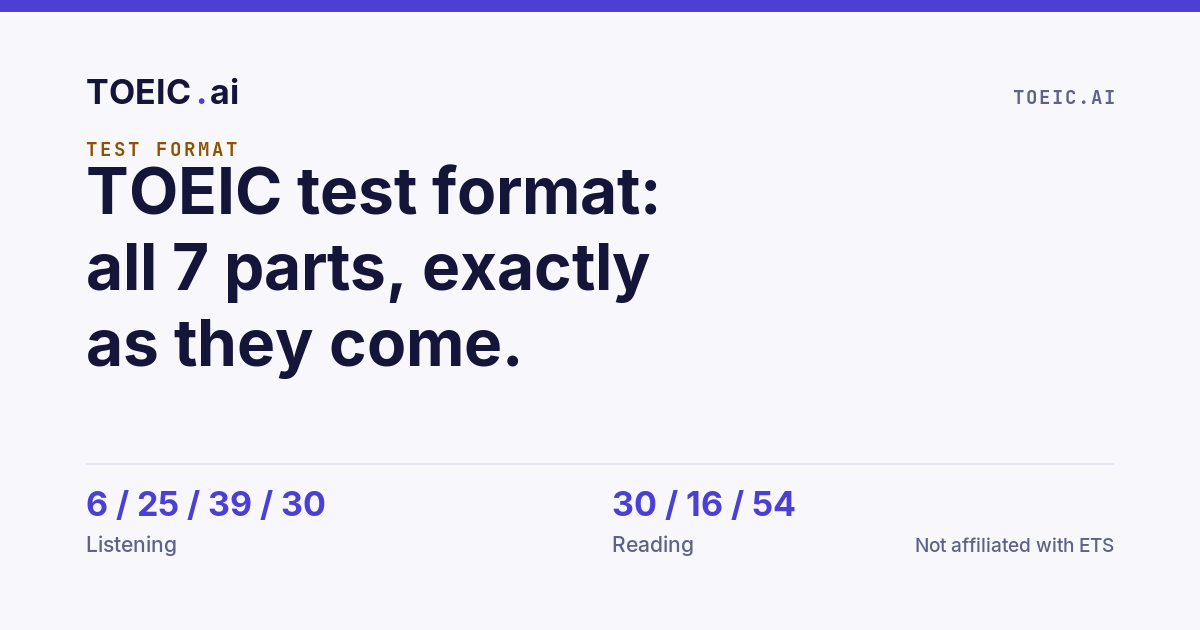
Your Reading score on the TOEIC Listening & Reading test rises when questions you now miss or never reach become correct answers. The Reading section gives you 100 questions in 75 minutes. There's no penalty for a wrong answer, so a blank is a sure zero while a blind guess wins about one time in four.
A stalled score usually moves after these changes, made in this order.
Why Is Your TOEIC Reading Score Not Improving?
A TOEIC Reading score usually stops improving because the practice no longer matches the cause of the lost points. Most test-takers keep doing untimed grammar or vocabulary work while their real loss is unanswered questions in Part 7 or repeated trap answers.
Four causes explain most stalls: running out of time, a vocabulary ceiling, unstable grammar and word forms, and misreading what a question asks. ETS reports Reading on a 5-495 scale, and a score plateau often means the same 10 to 15 questions go wrong in every mock. Extra work on strengths won't move it.
The fix starts with finding which questions you lose and why; the TOEIC Reading section page covers the full format.
How Do You Find Your Weak Points in TOEIC Reading?
Find your weak points by taking one full timed mock, then tagging every wrong or blank answer with a single cause and counting the tags by part. The biggest count in your error log decides what you study first.
Keep blank answers apart from wrong answers. Blanks point to pacing, while wrong answers point to knowledge or a trap in the question type. Recount after every timed mock, so you measure progress by part and not only by the total.
Each of the five causes sends you to a different fix in this article.
| Cause | What it looks like | Where it shows up most | Fix section |
|---|---|---|---|
| Ran out of time before finishing | Last questions left blank or guessed in a rush | Part 7, especially the multiple passages | Part order section, then the translation section |
| Unknown word blocked the answer | You couldn't tell what a key word meant | Part 5 vocabulary items and Part 7 passages | Vocabulary section later in this article |
| Word form or grammar slip | Wrong ending chosen, such as a noun for an adverb | Part 5 and the Part 6 blanks | Part 5 Incomplete Sentences section below |
| Misread the question or paraphrase | You answered a different question than the one asked | Part 7 detail and inference questions | Part 7 section on paraphrase and scanning |
| Fell for a distractor trap | You chose the option that repeats passage words | Part 7 and the Part 6 sentence choices | Common mistakes section near the end |
How Do You Raise Your Score on Part 5 Incomplete Sentences?
Raise your Part 5 score by deciding first whether a blank tests word form, verb pattern or vocabulary, then answering word-form items from the words around the blank. Keep each question to about 30 seconds or less.
Incomplete Sentences gives you 30 single sentences, each with one blank and four options, and it tests business grammar and vocabulary. The TOEIC Part 5 guide owns the full strategy, so this section sticks to what raises the score.
Most lost Part 5 points come back through five habits.
- Spot word-form items from the option endings. When the four options share one root, such as decide, decision, decisive and decisively, the gap's position tells you which form fits.
- Learn gerund and infinitive verb patterns. Verbs such as avoid and consider take gerunds, while plan and agree take infinitives, so memorize the common pairs in short lists.
- Memorize fixed prepositions and collocations. Phrases like "responsible for", "in charge of" and "comply with" come back often, and you can't reason your way to them under time pressure.
- Cap each question at about 30 seconds. Lingering on one hard item steals time from Part 7, where the longest questions wait at the end of the section.
- Log every miss by grammar point. Tag each Part 5 error as word forms, verb pattern, preposition or vocabulary, then drill only the tag that keeps growing.
How Do You Use Context Clues in Part 6 Text Completion?
Use context clues in Part 6 by reading the whole text around each blank, including the sentences before and after it. The right conjunction, tense or inserted sentence depends on the passage, not only on the sentence with the blank.
Per ETS, Text Completion has 16 questions across four short business texts. Some choices are full sentences, and these sentence insertion items need the whole text.
Transition words such as however, in addition and as a result signal contrast, addition or result. The document type, whether an email, notice, memo or advertisement, predicts tone and vocabulary. Read the full text once instead of jumping blank to blank. Our TOEIC Part 6 guide covers the full strategy.
How Do You Improve Speed and Accuracy in Part 7 Reading Comprehension?
Improve Part 7 speed and accuracy by reading the questions before the passage, skimming for the main idea and scanning for the names, dates and numbers the questions ask about. Then use elimination on options that are clearly wrong.
Reading Comprehension holds 54 questions: 29 on single passages and 25 on double passages and triple passages, all workplace documents. Main-idea and inference questions need the whole passage, while detail questions fall to scanning. The correct option usually relies on paraphrase, rewording the passage instead of repeating it, and cross-reference questions make you connect two or three texts.
The TOEIC Part 7 page covers each passage type in detail. Five moves make this part faster and more accurate.
- Read the questions before the passage. Knowing that a question asks for a date or reason tells you what to hunt for, so your first read has a purpose.
- Skim the title, opening lines and conclusion. Skimming these parts gives you the document's purpose in seconds, which answers many main-idea questions without a full read.
- Scan for names, dates and numbers. Scanning means moving your eyes fast for one target, such as a price or a meeting time, and reading closely only around it.
- Match paraphrases, not repeated words. If the passage says "postponed" and an option says "moved to a later date", that paraphrase is usually the answer the test wants.
- Eliminate clearly wrong options. Elimination works fastest on options that contradict the passage or mention something it never covers, which often leaves two choices to compare.
What Part-by-Part Drills Raise Your TOEIC Reading Score?
Drill each part in short timed units that copy its format: timed sets of ten for Part 5, one whole text for Part 6 and one passage set for Part 7, with a review step after every unit. The fixes above tell you what to change, and these drills turn them into a daily routine.
The time targets below are practice targets derived from the ETS question counts, not ETS rules. Pace in words per minute belongs to our TOEIC reading speed guide. Each drill pairs one unit of practice with a time target and a review step.
| Part | Drill unit | Time target | Review step |
|---|---|---|---|
| Part 5 (30 questions) | Timed sets of ten single sentences | About 3 minutes 20 seconds per set | Tag each miss as tense, preposition, word form, pronoun or vocabulary |
| Part 6 (16 questions) | One full text with its four blanks | About 2 minutes per text | Reread the paragraph around each missed sentence insertion item |
| Part 7 (54 questions) | Single passages first, then double passages and triple passages | About one minute per question | Note which two texts each cross-reference question linked |
Three habits make these drills pay off.
- Check the date line and time words before choosing a tense in Part 6. The right tense often depends on a sentence outside the one with the blank, so read around it first.
- Leave inference and sentence insertion questions until last within a Part 7 set. They take longer than detail questions, so answer the quick ones before the clock runs down.
- Link facts across double and triple passages. Expect questions that combine two texts, such as a price in an advertisement and a quantity in the email that answers it.
Run the drills between full mocks, and use a timed TOEIC practice test to check that the gains hold under real timing.
Should You Start the TOEIC Reading Test With Part 7?
Starting with Part 7 can help if you regularly leave Part 7 questions blank, but it isn't required. For most test-takers the safer rule is to keep the order and protect Part 7 time by moving fast through Part 5 and Part 6.
Part 7 first secures the 54 longest questions; Part 5 first builds momentum but risks a rushed ending. The 75-minute limit covers all three parts with no audio pacing, so time management is yours.
Mark and skip a hard question instead of stalling. Save the last minute to fill every blank, since there's no penalty for a wrong answer and a guess beats blank answers. Test any part order in a timed mock first; our planned TOEIC reading speed guide sets time budgets.
How Do You Build Vocabulary That Raises Your Reading Score?
Build vocabulary that raises your Reading score by learning workplace words in the phrases and documents where TOEIC uses them, and by reviewing the words you actually missed in your mocks.
A thin workplace vocabulary costs you twice. Part 5 accuracy drops when you can't tell two options apart, and Part 7 speed drops when unknown words make you reread. Our TOEIC vocabulary lists group the words by topic.
Vocabulary work pays off fastest when you build it in five ways.
- Learn collocations, not single words. "Submit a proposal" and "meet a deadline" stick better than the verbs alone, and Part 5 often tests exactly that pairing.
- Study word families together. Learn one root in four forms, such as succeed, success, successful and successfully, so any word-form question on that root becomes quick.
- Group words by workplace topic. Build sets for hiring, finance, travel, purchasing and facilities, because TOEIC passages return to these business settings again and again.
- Review words missed in each mock. Add every unknown word from your error log to a review deck, with the sentence where it appeared, and test yourself weekly.
- Read real business English daily. Ten to fifteen minutes of mass media such as business news and company announcements trains you to meet workplace terms in context.
Why Shouldn't You Try to Translate in TOEIC Reading?
Mental translation slows reading because every sentence is processed twice, once in English and once in your native language. Reading in chunks of meaning instead of word by word is one of the most direct ways to finish Part 7.
Chunking means grouping words into phrases, such as a subject plus its verb or a preposition with its object, and reading for the idea. When you meet an unknown word, keep going if the sentence still makes sense.
Easy, longer texts build automatic reading and raise your reading speed over a few weeks. Reading aloud also shows you exactly where comprehension breaks down.
What Common TOEIC Reading Mistakes Lower Your Score?
The mistakes that lower a TOEIC Reading score most are leaving blanks, overthinking Part 5, choosing options that repeat passage words, and reviewing mocks only by the total score. These common mistakes each pair with a direct fix, and our TOEIC mistakes page covers test-wide errors.
Every mistake here comes with its correction.
- Leaving blanks at the end: fill every answer. With no penalty for wrong answers, a blank scores zero, while a guess wins about one time in four.
- Overthinking Part 5: move on after 30 seconds. Mark the item, pick your best option and come back only if time remains at the end.
- Picking word-match options: look for paraphrase. Distractors often copy words straight from the passage, while the right answer restates the idea in different words.
- Changing answers without a reason: trust instincts. Keep your first well-reasoned answer unless you find new evidence in the text that clearly points elsewhere.
- Reviewing the total only: review by part and cause. A total hides whether you lost points to time, words or traps, so read your error log line by line.
- Cramming: practice steadily instead. Short daily sessions beat a final week of cramming, and timed practice under test stress prepares you for fatigue in the second half.
How Can You Keep Increasing Your TOEIC Reading Score?
Keep increasing your TOEIC Reading score by repeating one practice cycle: take a timed mock, update the error log, drill the largest cause for one to two weeks, then test again. Set the next target score from the score an employer or school asks for.
Here fixing problems turns into steady progress. Pick material that copies the real format: timed papers to measure, part drills to fix. A realistic target is the next requirement you need, not the top of the scale.
Test dates, fees and registration differ by country, so check them with the official administrator, such as IIBC in Japan or ETS Global in France, before you book a retake.
Can You Improve Your TOEIC Reading Score Online?
Yes, you can improve your TOEIC Reading score online with timed, full-length practice tests that mirror the 100-question, 75-minute format. Online practice works best when every attempt runs under real timing and feeds your error log.
On toeic.ai, the free plan includes fully marked mock tests, one full and one mini Listening & Reading test, plus unlimited unmarked timed practice papers. Start with a free TOEIC practice test and tag each miss by cause.
Are TOEIC Reading Improvement PDFs Worth Using?
Yes, a TOEIC Reading PDF is worth using when it comes with an answer key and real question counts, but it cannot time you or log your errors for you.
Use official ETS material as the reference for real item style, since ETS writes the test. For printable practice and offline study, set a clock for 75 minutes and mark your blanks as you would on test day. Our TOEIC preparation guide shows where PDFs fit into a full plan.
Is a TOEIC Score of 900 Considered High?
Yes, a TOEIC Listening & Reading total of 900 is considered high and is above what most employers and schools ask for.
Because Listening tops out at 495, a total score of 900 needs at least 405 in Reading. In practice, a TOEIC 900 usually shows a Reading score in the mid-400s, since Listening scores tend to run higher; treat that as a typical split, not a rule. Check each employer requirement on the posting, and see how the bands read on our TOEIC score page.
What TOEIC Score Is Equivalent to C1?
The TOEIC score equivalent to CEFR C1 is set by ETS separately for Listening and for Reading, so check the Reading threshold, not only the total.
The ETS mapping sets the C1 minimum at 455 for Reading and 490 for Listening (ETS CEFR mapping reference, checked October 7, 2026). ETS notes that the Reading C1 cut rests on 45 percent of its panelists, a weaker agreement than other levels, so treat 455 as the floor for that proficiency level. Our TOEIC to CEFR table maps every level.
Common Questions
Why is your TOEIC Reading score not improving?
A TOEIC Reading score usually stops improving because practice no longer matches the cause of the lost points. Many test-takers keep doing untimed grammar or vocabulary work while their real loss is unanswered Part 7 questions or repeated trap answers.
How do you find your weak points in TOEIC Reading?
Take one full timed Reading mock, tag every wrong or blank answer with a single cause (ran out of time, unknown word, word form or grammar, misread question or paraphrase, distractor trap), and count the tags by part. The largest count decides what to study first.
Should you start the TOEIC Reading test with Part 7?
It can help if you regularly leave Part 7 questions blank, but it is not required. For most test-takers the safer rule is to keep the order and protect Part 7 time by moving fast through Part 5 and Part 6.
Is a TOEIC score of 900 considered high?
Yes. A TOEIC Listening & Reading total of 900 is considered high and is above what most employers and schools ask for. Because Listening tops out at 495, it needs at least 405 in Reading.
What TOEIC score is equivalent to C1?
ETS sets CEFR C1 separately by section: a minimum of 455 for Reading and 490 for Listening, per the ETS CEFR mapping reference.