TOEIC Part 1 Photographs: Format, Topics, Traps and Tips
Overview
TOEIC Listening Part 1 opens the Listening section of the TOEIC Listening & Reading test: you see a photo in your test book, hear four spoken statements, and mark the one that fits. ETS calls the part Photographs. Most misses come from the verb form, so this guide includes a decoder of five verb patterns and what each one needs the photo to show. Here is the route through the part.
What Is TOEIC Listening Part 1?
TOEIC Listening Part 1, officially named Photographs, is the first of the four parts of the TOEIC Listening section. Each question shows one photograph and plays four short statements, (A) to (D), and you choose the statement that best describes the photo.
It comes before Part 2 Question-Response, Part 3 Conversations and Part 4 Talks. All four parts share one section of 100 questions that runs about 45 minutes, and ETS reports the result on the 5-495 scale.
Part 1 is the only part built around a picture. That makes it a precision check: does the verb, the preposition or the object noun you hear match what you can see? IIBC, which runs the test in Japan, lists the same six-question structure on its format page.
One clarification, because searchers mix these up. "TOEIC part 1" can also mean Speaking Questions 1-2, where you read a text aloud, or the Writing photo task. This page covers the Listening & Reading test only.
What Is the TOEIC Listening Part 1 Format?
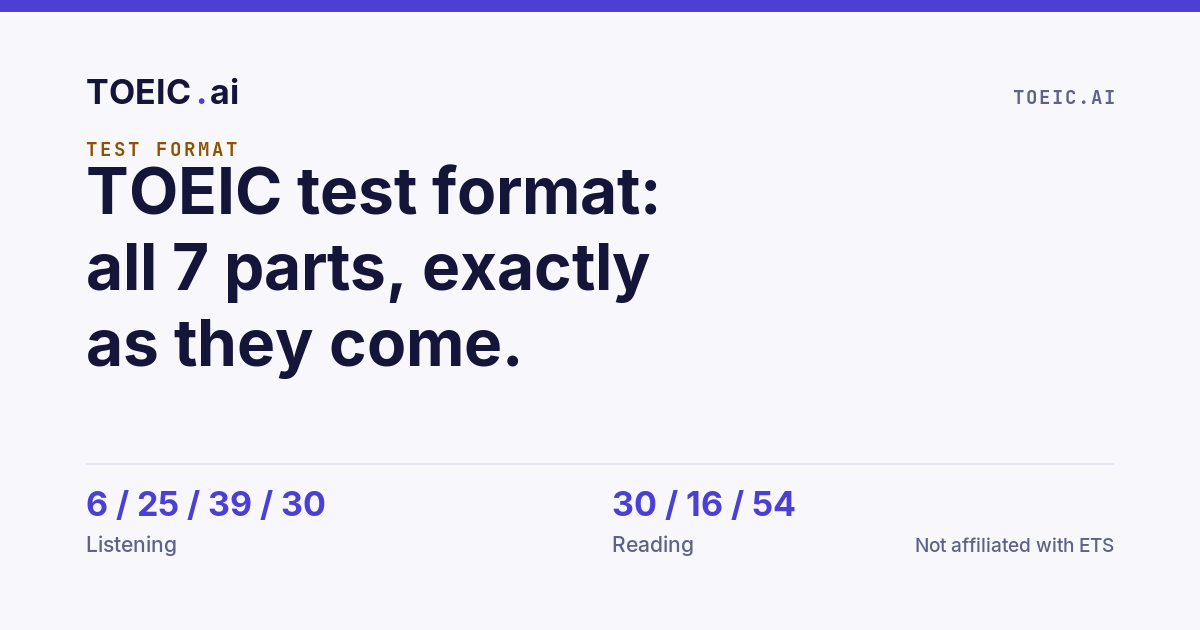
Part 1 has 6 questions, numbered as questions 1-6. For each one you see a photograph in the test book and hear four statements, (A) to (D), once. ETS states that the statements are not printed in the test book, and you mark one letter on your answer sheet.
The part starts with spoken directions and a sample photo with its answer, then the six scored items follow. Photos show one person, a group, or a scene with no people at all.
Older forms had 10 Part 1 questions. The updated test format cut the part to 6, and ETS records that it first appeared in Japan and Korea on May 29, 2016; other countries switched later, Thailand from January 1, 2020. That is why older books and PDFs may still show 10 photos. Scores count correct answers only, so a wrong answer costs you nothing more than a blank.
Every Part 1 item runs on the same short pattern, summarized in this table.
| Feature | Part 1 detail |
|---|---|
| Number of questions | 6 photo questions in the current format |
| Question numbers | Questions 1-6, the first items of the Listening section |
| What is printed in the test book | One photograph per question and no statement text |
| Spoken options per photo | Four statements, labeled (A), (B), (C) and (D) |
| Times the audio plays | Once only, with no replay |
| Penalty for wrong answers | None; your score counts correct answers |
| Older format (pre-update) | 10 photo questions, before the 2016 update |
How Should You Allocate Time in TOEIC Listening Part 1?
The audio sets the pacing, so time allocation in Part 1 means using the few seconds you control. Preview the photo, judge each statement as it plays, mark during the answer pause, and look at the next photo straight away.
Each item follows one rhythm, from photo preview to answer mark. ETS doesn't publish the exact length of the answer pause, so treat any second-by-second split you find online as a guess and time the gap yourself on the official sample audio. The spoken directions are the same on every test, which frees that time to scan photo 1 and photo 2.
One item breaks into four moves, repeated six times.
- Scan the photo during the directions or the previous pause, naming the people, actions and objects silently.
- Judge each statement as it plays, keeping a mental tick or cross for (A) through (D).
- Mark the letter in the pause, choosing the one statement still standing after your checks.
- Move your eyes to the next photo at once, even if you're unsure about the last answer.
What Is an Example of a TOEIC Listening Part 1 Question?
You see a photo, for example a man stacking boxes on a shelf in a warehouse, and hear four statements. Statement (A) says he's opening a box. (B) says he's placing a box on a shelf. (C) says the shelves are being painted, and (D) says the boxes have been delivered to an office. Only (B) matches what the photo shows.
To read any example well, give the photo description in a few words, say why the correct answer is true, and name the trap in each distractor. The three items below are original practice items written in TOEIC style, not copies of ETS questions.
Three short items cover the patterns Part 1 repeats most.
- A one-person photo with an action in progress. Photo: a woman watering plants on an office windowsill. (A) "She's filling a watering can." (B) "She's watering some plants." (C) "The plants are being moved." (D) "She's closing the window." Answer: (B). (A) pairs a real object with the wrong action, (C) needs someone moving plants, and (D) describes something she isn't doing.
- A group photo where the answer describes what everyone is doing. Photo: four people seated at a conference table, all facing a screen. (A) "They're standing by a screen." (B) "They're looking at a presentation." (C) "A screen is being installed." (D) "They're leaving the room." Answer: (B), the shared action. (A) gets the position wrong, (C) needs a worker installing, and (D) is an action nobody performs.
- A photo with no people where the answer describes position or state. Photo: bicycles locked to a rack outside a café, no one in sight. (A) "A man is riding a bicycle." (B) "There are bicycles in a rack." (C) "The bicycles are being repaired." (D) "Tables are being set up outside." Answer: (B). Every other option needs a person acting, and the photo shows nobody.
Treat each one as a sample question drill: cover the transcript, describe the photo out loud, then check your choice.
Which Topics Are Often Included in TOEIC Part 1 Photos?
Part 1 photos show everyday work and public settings: office environments and meetings, airports and train stations, stores and checkout lines, and outdoor streets, parks and construction sites.
Knowing the settings helps because each one brings a predictable set of everyday objects and actions. If you can name them in English before the audio starts, the statements become checks rather than surprises. The photos are ordinary scenes, never specialist ones.
These six scenes return on test after test.
- Offices and meetings: desks, monitors, filing cabinets, a whiteboard, and someone who "is typing" or "is handing out documents" to colleagues.
- Airports, train stations and transit hubs: platforms, luggage carts, departure boards, ticket machines, and passengers who are boarding or waiting in line at a gate.
- Stores, shopping areas and checkout lines: shelves, merchandise, a cash register, shopping baskets, and a clerk who "is bagging items" or stocking shelves.
- Restaurants and kitchens: menus, trays, aprons, a chef chopping vegetables, a server pouring water, and chairs stacked on tables after closing.
- Outdoor streets, parks and construction sites: scaffolding, a ladder, a wheelbarrow, a hard hat, park benches, and a road that "is being repaired."
- Warehouses and workshops: pallets, a forklift, boxes on shelves, tools on a workbench, and a worker who "is loading a truck" in safety gloves.
Build workplace vocabulary by setting with the word lists on the toeic.ai vocabulary page (toeic.ai/vocabulary).
What Are the Common Traps in TOEIC Listening Part 1?
Most wrong Part 1 statements fail in one of four ways: the wrong verb form, an object you cannot see, an object in the wrong place, or a sound-alike word for something in the photo.
The traps work because test-takers match one familiar noun and stop listening to the verb or the preposition. Correct statements also lean on paraphrasing, so the right answer may say "vehicle" or "merchandise" instead of the exact object you expected. Never choose a statement that adds what the photo can't show, such as what someone is thinking or where they're going.
Each verb form makes a different promise about the photo, and the table sets out all five. The present progressive passive, the present perfect passive and the stative passive are where most candidates slip.
| Verb form | Example statement | What the photo must show | Typical trap |
|---|---|---|---|
| is/are + -ing (active, in progress) | "A man is climbing a ladder." | A person visibly doing that action at the moment the photo was taken. | The man only stands next to the ladder, so the action isn't happening. |
| is/are being + past participle (present progressive passive) | "The windows are being cleaned." | Someone acting on the object right now, such as a worker wiping the glass. | Clean windows with nobody working on them anywhere in the frame. |
| has/have been + past participle (present perfect passive) | "The chairs have been stacked." | A finished result with no one acting, the chairs already piled up. | A person still stacking chairs, which calls for the "being" form instead. |
| is/are + past participle (stative passive) | "The door is closed." | A state or position that anyone could see in a still photo. | Mixing it up with "is being closed," which needs someone closing the door. |
| there is/are + noun + place phrase | "There's a lamp on the desk." | That exact object sitting in exactly that location. | Right object, wrong place: the lamp stands beside the desk, not on it. |
Four more traps catch listeners who stop at the noun.
- Object not in the photo: "She's putting on her glasses" when no glasses appear anywhere. If you can't point to the object, cross the statement out.
- Wrong preposition or position: "The printer is under the desk" when it sits on top. Prepositions of place decide many items, so check each one carefully.
- Sound-alike words: a photo of someone walking comes with "He's working," or a copier photo with "coffee." These traps reward matching sounds instead of meaning.
- Assumed intention or future action: "They're going to catch a train" adds a plan the photo cannot show, because a still image only shows the present moment.
General test-day errors live on the TOEIC mistakes page (toeic.ai/mistakes).
What Strategies Help You Score High in TOEIC Listening Part 1?
High scorers scan the photo before the audio starts, name the people, actions, objects and their positions, listen to the verb in every statement, and cross out any statement that mentions something they can't see.
These habits fit the short rhythm of each item: photo analysis before the audio, verb and preposition checks during it, and elimination in the pause. With six items, Part 1 is a small share of the 100 Listening questions, so a calm, quick start matters more than perfection.
Strong scorers repeat one routine on all six photos.
- Analyze the photo before listening: name the main action first, then the people, the key objects and where each one sits in the frame.
- Focus on the verb in each statement: decide whether it describes an action in progress, a finished result or a state, then compare it with the photo.
- Check prepositions against positions: on, under, beside and in front of all matter, so confirm object positions before accepting a statement with the right nouns.
- Reject anything you cannot see: a missing object, a hidden feeling or a future plan rules a statement out, however natural the sentence sounds.
- Expect paraphrases, not exact nouns: the correct answer often says "vehicle," "equipment" or "merchandise," so a paraphrase of what you see can still be right.
- Mark by elimination and never leave a blank: keep your pencil on the answer sheet, cross out letters as they fail, and use guessing when two remain.
How Can You Practice TOEIC Listening Part 1 With Audio?
Practice with audio played once at real speed, starting with the ETS sample questions and moving to timed mock tests, so your practice matches test conditions.
The free TOEIC mock tests on toeic.ai include one full and one mini marked Listening & Reading mock test on the free plan, plus unlimited unmarked timed practice papers. Useful Part 1 practice has four parts: a photo, four spoken statements you cannot read, the short answer pause, and a review afterward with the transcript.
PDF sets and an answer key help with transcripts and vocabulary, but reading a transcript isn't listening practice. When you review a miss, name the verb form or trap from the decoder table above. After one or two timed practice sessions, those tags tend to cluster on one or two rows, and those rows are your next drill. Our guide to improving your TOEIC Listening score turns those drills into a full plan.
Is There a Free TOEIC Listening Part 1 PDF With an Answer Key?
Yes, free TOEIC Part 1 PDFs with answer keys exist, and the ETS sample test includes Part 1 photos with audio, but a PDF only helps when you use it with its audio.
Treat any free PDF or free download as a vocabulary and transcript resource, and check its date: older files may still show the pre-2016 10-question Part 1. For audio under timed conditions, the free plan behind our TOEIC practice test includes marked full and mini Listening & Reading mock tests and unlimited unmarked timed practice papers.
How Long Does It Take to Complete the TOEIC Listening Test?
The TOEIC Listening section takes about 45 minutes for 100 questions, and Part 1's six photo questions take only the first few minutes.
The test is audio-paced. The recording doesn't stop or replay, so once Part 2 starts, Part 1 is over. The full Listening & Reading test lasts about 2 hours for 200 questions. Our guide to the TOEIC Listening section covers all four parts in order.
Is the TOEIC Test Hard?
No, the TOEIC Listening & Reading test is not hard in the pass-or-fail sense, because there is no pass mark. TOEIC difficulty depends on the score you need, and Part 1 is usually the most approachable part.
ETS reports results on the 10-990 scale, and each school or employer sets its own score requirements. Part 1 is short and visual, so it rewards work on verbs and setting vocabulary more than raw listening speed. For a full plan, start with our TOEIC preparation guide and its test preparation steps.
Is a TOEIC Score of 960 Considered Good?
Yes, 960 out of 990 is an excellent TOEIC Listening & Reading score, close to the maximum and above what almost any employer or school asks for.
A 960 score leaves room for only a handful of misses across the whole test, Part 1 included. On CEFR C1, note that ETS maps each section separately: C1 starts at 490 in Listening and 455 in Reading, so a 960 reaches C1 only when both halves clear their minimum. Each organization sets its own score requirements against the 990 maximum; our TOEIC score page explains how to read them.
Common Questions
What is TOEIC Listening Part 1?
TOEIC Listening Part 1, Photographs, is the first of the four Listening parts. Each question shows one photograph and plays four short statements, and you choose the one that best describes the photo.
What is the TOEIC Listening Part 1 format?
Part 1 has 6 questions, numbered 1-6. For each, you see a photograph in the test book and hear four statements once. The statements are not printed, and you mark one letter on the answer sheet.
What are the common traps in TOEIC Listening Part 1?
Most wrong statements use the wrong verb form, name an object you cannot see, put an object in the wrong place, or use a word that sounds like something in the photo.
How long does it take to complete the TOEIC Listening test?
The Listening section takes about 45 minutes for 100 questions, and Part 1's six photo questions take only the first few minutes.
Is a TOEIC score of 960 considered good?
Yes. 960 out of 990 is an excellent TOEIC Listening & Reading score, close to the maximum and above what almost any employer or school asks for.