How to Improve TOEIC Listening Score: Format, Parts, Plan
Overview
Improving your TOEIC Listening score starts with turning the 100-question, roughly 45-minute Listening section of the TOEIC Listening & Reading test into four parts you can predict, each with its own trap and fix. Scoring runs on a 5-495 scale, the audio played once is all you get, and the answer options you can see change by part. Seven habits earn most Listening points.
What Is the TOEIC Listening Test Format?
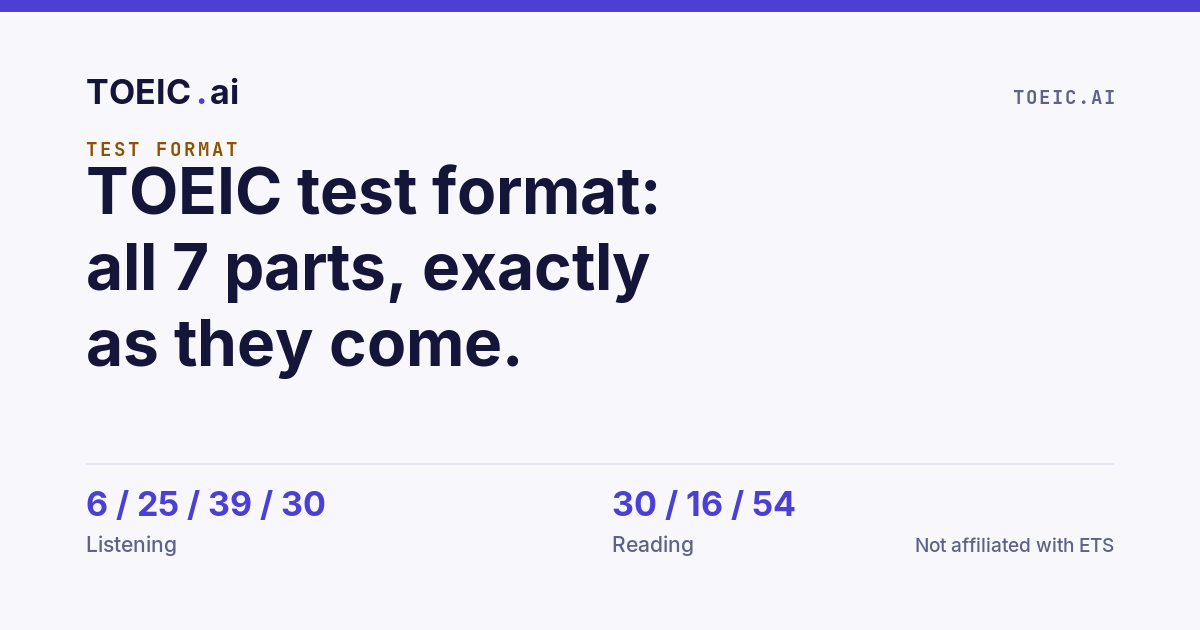
The TOEIC Listening section has 100 questions in four parts (Photographs 6, Question-Response 25, Conversations 39, Talks 30), lasts about 45 minutes, plays each recording once and is scored 5-495. The parts grow from single statements to short exchanges, then to longer conversations and talks. Our TOEIC format page covers the Reading half too.
ETS's redesign brochure says speakers use American, British, Canadian and Australian accents. Part 3 includes some three-speaker conversations. Some Part 3 and Part 4 sets add graphic questions, where you match the audio to a printed table or schedule. ETS applies no penalty for a wrong answer.
What the test book prints differs by part, and that difference decides how you should prepare.
| Part | Questions | Answer options | What the test book shows | Tip it changes |
|---|---|---|---|---|
| Part 1 Photographs | 6 | 4, spoken only | The photograph only | Study the photo first; crossing out two options leaves a 50/50. |
| Part 2 Question-Response | 25 | 3, spoken only | Nothing beyond the directions | Removing one wrong response already leaves you a 50/50 choice. |
| Part 3 Conversations | 39 (13 sets of 3) | 4, printed | Questions and options, some graphics | Read all three questions before the audio, then match any graphic. |
| Part 4 Talks | 30 (10 sets of 3) | 4, printed | Questions and options, some graphics | Use spare seconds after each talk to preview the next three questions. |
What Are the Essential TOEIC Listening Strategies?
The strategies that work on every part are reading ahead, listening for paraphrases, eliminating wrong options, answering every question and moving on without dwelling on a missed item. They carry across all four parts because each part tests the same skill: matching the meaning you hear to an option, at a pace the recording sets.
The directions are identical on every test form, so you don't need to listen to them. Correct answers usually restate the audio in synonyms rather than repeating it. With no penalty for wrong answers, a blank always costs a point.
Five habits pay off on all 100 questions, whichever part you're in.
- Preview questions and options during the directions. The directions never change, so spend that time reading the first Part 3 questions or studying the first Part 1 photo.
- Listen for paraphrases, not repeated words. A correct answer usually says the same thing in new words, so "postponed" in the recording becomes "delayed" in the right option.
- Eliminate clearly wrong options first. The process of elimination narrows four options to two, and on Part 2 a single removal already leaves you a 50/50 guess.
- Answer every question, guessing as a last resort. Because wrong answers cost nothing, an educated guess sometimes earns a point, while a blank never does.
- Keep moving after a missed question. Trust your first instinct, mark your best guess and refocus, because the next recording starts whether you're ready or not.
How Do You Answer TOEIC Listening Part 1 Photographs?
Before the four statements play, scan the photo for who, what, where and the action under way, then pick the statement that matches what is visible or clearly implied. Part 1 has six photos, and each comes with four spoken statements that aren't printed. A dedicated TOEIC Part 1 guide covers more, so this section sticks to the essentials.
Grammar does much of the work here. The present continuous tense ("is walking") describes people in action. The passive voice splits objects in place into "is being moved" (someone is doing it now) and "has been moved" (already done). A correct statement can describe an implied situation, while wrong ones often name an object in the photo but attach the wrong action.
A ten-second look at the picture settles most Part 1 items.
- Scan people, objects, place and action: note who is there, what sits where, the setting and the main action before the narrator reads statement A.
- Listen for the verb tense: "is walking" describes someone moving now, so a statement about the past or future rarely fits a single still photo.
- Separate "is being" from "has been": "chairs are being stacked" needs a person stacking them, while "chairs have been stacked" fits an empty room with neat piles.
- Expect inferences, not only visible objects: a statement like "the meeting has ended" can be correct when empty cups and pushed-back chairs make that plain.
- Reject right-noun, wrong-action statements: if the photo shows a ladder and the statement says someone is climbing it, check that someone actually is.
How Do You Handle Part 2 Question-Response Items?
Catch the first word of the question (who, what, when, where, why, how, or a yes/no opener), then choose the response that fits it, even if it is indirect. Part 2 plays 25 spoken questions or statements, each followed by three spoken responses, and nothing is printed. A dedicated TOEIC Part 2 guide covers every question type.
Indirect answers such as "Let me check the schedule" are often correct, because real colleagues answer that way. With only three answer options, removing one wrong response leaves a 50/50, so elimination pays off faster here than in any four-option part. Part 2 often feels harder than expected on a first timed attempt, because nothing is printed to fall back on.
The first two or three words you hear usually decide a Part 2 item.
- Lock onto the question word. Question words like "when" and "where" set the answer type, so "next Tuesday" fits a when-question and "in the lobby" does not.
- Accept indirect and clarifying answers. "Did you send the invoice?" can be answered by "Maria handled it yesterday," and yes/no questions often get no yes or no at all.
- Distrust options that repeat a word. Word echoes are classic traps, so a question about a sales report may pair with "I reported it already," which answers nothing.
- Eliminate one option to reach a 50/50. With three responses, one confident removal lifts a blind guess from one in three to one in two.
- Let a missed question go immediately. The next item starts within seconds, so mark your best guess and listen fresh instead of replaying the last one.
How Do You Tackle Parts 3 and 4 Conversations and Talks?
Read the three printed questions for each set before the audio starts, listen for the answers in the order the questions are asked, and mark each answer as soon as you hear it. Part 3 has 13 short conversations and Part 4 has 10 short talks. Each set carries three questions, with the questions and options printed. A Part 3 guide is planned, and the TOEIC Part 4 guide covers talks in depth.
Questions follow the chronological order of the recording, so the first answer arrives early. Graphic questions make you match what you hear to a printed table or schedule. Intended meaning questions ("What does the woman mean when she says...") test a line in context, not its dictionary sense. Part 4 talks include announcements, voicemails, advertisements and tours.
Reading ahead pays off more in these two parts than anywhere else on the test.
- Preview the three questions before each set. Underline the key words, such as who, where or what happens next, so you know which detail to catch before anyone speaks.
- Follow the chronological order of answers. The answer to the first question usually comes first, so if you hear the second answer, the first has probably passed.
- Match graphics to what the speakers say. The options often list one column of the graphic while the audio gives the other, such as a time instead of a room.
- Read intended-meaning questions in context. Ask why the speaker said the quoted line, since "The printer's been acting up" can explain a delay rather than report a fault.
- Mark answers immediately and move ahead. Fill the bubble the moment you hear the answer, then use the remaining seconds to preview the next three questions.
What Are Common TOEIC Listening Mistakes and How Do You Avoid Them?
Most lost Listening points come from a handful of common TOEIC mistakes: sound-alike traps, word echoes, dwelling on a missed question, translating in your head and leaving answers blank. They cost more in Listening than in Reading because the audio plays once and the test sets the pace. In Reading you can go back, but in Listening falling behind on one item can cost the next two.
Every one of these mistakes has a direct counter-move.
- Choosing sound-alike words: homophones and near-homophones such as "copy" and "coffee" are deliberate distractors, so confirm the option makes sense, not just that it sounds familiar.
- Picking the option that echoes the question: a repeated word feels safe but rarely answers anything, so choose the response that fits the question word instead.
- Dwelling on a missed question: replaying it in your head costs you the next item too, so guess, let it go and refocus on the next recording.
- Translating into your first language: the translation habit adds a delay the audio doesn't allow, so practice answering in English with short, timed drills.
- Previewing too late in Parts 3 and 4: reading options while the audio is already playing splits your attention, so finish each set early and read ahead.
- Leaving answers blank: blank answers always score zero while a guess might score, so fill every bubble before the section ends.
How Can You Improve Your TOEIC Listening Skills Every Day?
Improve your Listening ear in five steps: listen daily to workplace English, shadow short clips, take dictation, check transcripts, and raise the playback speed over time. Those five steps answer the common question of how to improve listening skills, as long as the material sounds like the test: business news, workplace podcasts, and airport or office announcements.
Reading aloud improves sound recognition, because you learn how words blur together in connected speech. Practicing at 1.25x speed makes test-speed audio feel slower on the day. Our list of TOEIC idioms and phrases collects the phrasal verbs that turn up in the audio. Keep a notebook of workplace collocations you hear, such as "submit a proposal" or "push the meeting back."
Twenty focused minutes a day, split across these steps, builds the habit.
- Listen to workplace English daily. Pick business news or a workplace podcast and listen for 10 minutes, noting phrases that sound like office calls or announcements.
- Shadow short clips aloud. In shadowing, you repeat a speaker half a second behind, copying rhythm and stress until reduced forms stop surprising you.
- Take dictation of one-minute passages. Write down every word of a short clip, because dictation shows exactly which sounds you miss in a way no score can.
- Check every gap against a transcript. Compare your dictation with the transcript, then replay each missed phrase until you can hear it clearly at normal speed.
- Raise playback speed gradually. Move from 1.0x to 1.1x and then 1.25x playback speed over a few weeks, so real test audio starts to feel comfortable.
How Should You Build a TOEIC Listening Preparation Plan?
Set a target Listening score, take a timed baseline test, find your weakest part, drill it, and retake a full timed Listening section every two to three weeks. This plan divides study time by weakness instead of spreading it evenly, so the part costing you the most points gets the most hours.
Take your target score from the requirement your employer or school sets. Isolate weak points by part, not by overall score, because a decent total can hide a weak Part 3. Avoid cramming in the final week, and rest before test day. Test dates, registration and fees differ by country, so check the official ETS site or your local TOEIC administrator rather than a quoted figure.
Each cycle runs through the same five steps until you hit the target.
- Set a target Listening score. Read the score your employer or school publishes, check whether it sets a separate Listening minimum, then add a small safety margin.
- Take a timed baseline test. Sit a full-length practice test under real timing; the toeic.ai free plan includes one full and one mini marked Listening & Reading mock.
- Isolate your weakest part. Sort your misses by part, not by total, because the part with the lowest accuracy is where your next two weeks of study belong.
- Drill that part daily. Use timed practice on that part only, review every miss to find the trap that caught you, then repeat with fresh items.
- Retake a full timed section every two to three weeks. A full-length mock test shows whether the drills moved your score and which part to target next.
The free plan also includes unlimited timed practice papers, which stay unmarked, so you check those answers yourself.
Where Can You Get Free TOEIC Listening Practice and Track Your Score?
Free Listening practice comes from official ETS sample questions, free online mock tests with real timing, and public English audio. Track progress by repeating timed Listening sections and comparing the scaled score. Practice turns into a measured score only when you time and score it the same way each attempt, so progress tracking means comparing like with like.
Most candidates need only three kinds of free material.
- Official ETS sample questions: the official sample questions from ETS show real item styles, directions and audio quality, so start with them before trying any other source.
- Free online timed mock tests: an online mock test with real timing and a scaled score estimate lets you compare one attempt with the next on equal terms.
- Public workplace English audio: business news, podcasts and recorded announcements build your ear between tests, though they won't give you a score to track.
The Reading section needs its own set of TOEIC Reading tips, since it tests grammar, vocabulary and reading pace rather than listening.
Can You Give an Example of a TOEIC Listening Question?
Yes, a typical Part 2 item plays a short question such as "When does the shipment arrive?" followed by three spoken responses, and the best one answers the "when". This sample item is original, written for this page.
- (A) "It's arriving at Dock 3."
- (B) "Thursday morning, according to the tracking page."
- (C) "I shipped it myself."
B is correct because it gives a time. Option A answers "where," and C is an echo option that repeats "ship" without giving a time. This Part 2 example proves that the question word outweighs vocabulary, and our guide to the TOEIC Listening section explains every part in detail.
Are Free TOEIC Listening Practice Tests Online Enough?
No, free online Listening practice is enough to learn the format, but reaching a specific target score also needs timed full sections and a review of every miss. A free practice test teaches you the item types, while error review tells you why you lost points.
The toeic.ai free plan includes fully marked mock tests (one full and one mini Listening & Reading test) plus unlimited unmarked timed practice papers. Start with a free TOEIC practice test and sort every wrong answer by part.
Is an 810 TOEIC Score Considered Good?
Yes, 810 out of 990 is a strong TOEIC score; whether it is enough depends on the score the employer or school requires. ETS maps B2 level to 400 in Listening and 385 in Reading, which add up to the commonly cited 785, so 810 sits just above it. Check the required score and any section minimum, since a Listening score under 400 can miss B2 even when the total clears 785. Our TOEIC 800 score guide covers that target in depth.
Is There a TOEIC Listening and Reading Score Conversion Table?
No, ETS does not publish one fixed conversion table; it converts correct answers to a 5-495 scaled score per section, and the conversion is adjusted for each test form. The ETS examinee handbook calls this process equating, which adjusts for test-form difficulty.
Unofficial raw score to scaled score tables online are estimates, useful for tracking practice progress but not exact predictions, since every score conversion depends on the form you sit. Our TOEIC score guide explains how the scale works.
Common Questions
What is the TOEIC Listening test format?
The TOEIC Listening section has 100 questions in four parts (Photographs 6, Question-Response 25, Conversations 39, Talks 30), lasts about 45 minutes, plays each recording once and is scored 5-495.
What are the essential TOEIC Listening strategies?
Read ahead, listen for paraphrases, eliminate wrong options, answer every question because there is no penalty for wrong answers, and move on without dwelling on a missed item.
How do you handle Part 2 Question-Response items?
Catch the question word, then choose the response that fits it, even if it is indirect. Part 2 has only three options, so removing one wrong response already leaves a 50/50.
Is an 810 TOEIC score considered good?
Yes. 810 out of 990 is a strong score, just above the commonly cited 785 B2 total (400 Listening plus 385 Reading on the ETS mapping). Whether it is enough depends on the score your employer or school requires.
Is there a TOEIC Listening and Reading score conversion table?
No. ETS converts correct answers to a 5-495 scaled score per section and adjusts the conversion for each test form, so unofficial raw-to-scaled tables are estimates only.