10 TOEIC Tips: Timing, Listening, Reading and Test Day
Overview
The TOEIC Listening & Reading rewards test-taking strategy as much as English. Each tip is an exam-room tactic; study routines live on a separate page. These ten, in test-day order, add the most toward a higher score.
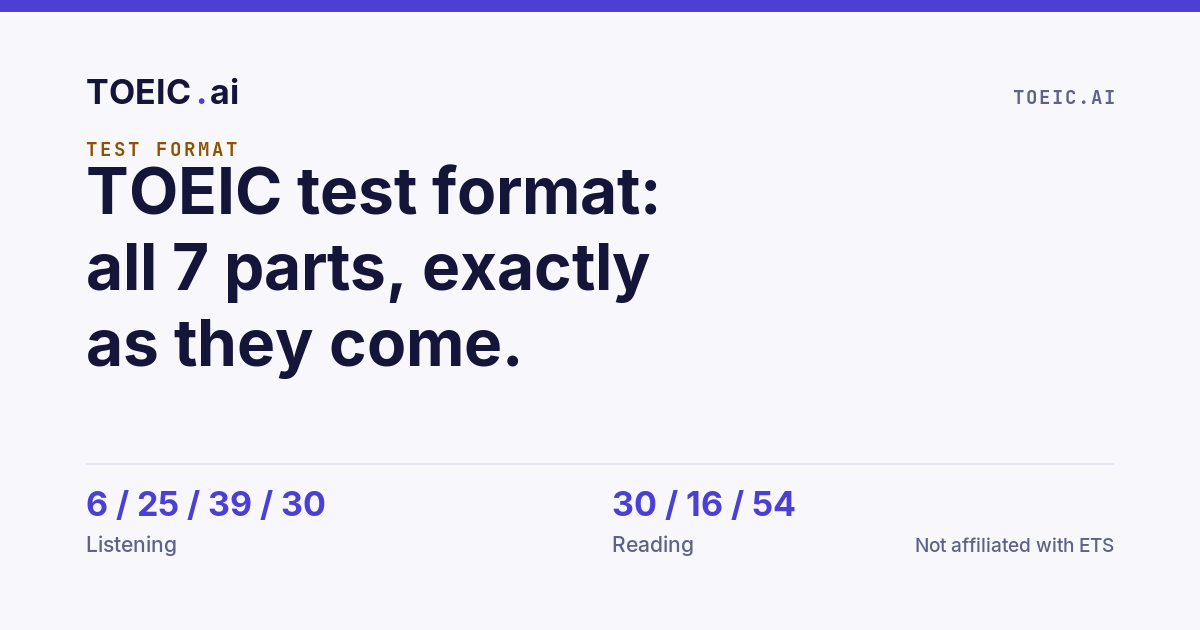
- Get to know the test format: 200 questions across seven parts.
- Be aware of time management, especially in the 75-minute Reading section.
- Guess as a last resort and never leave blanks: no penalty for wrong answers.
- Preview the questions in Listening Parts 3 and 4 before the audio.
- Listen quickly for who, what, where and when in Parts 1 and 2.
- Focus on Part 7 with a skim-and-scan strategy built on keywords.
- Use grammar clues to settle Part 5 and Part 6 items fast.
- Eliminate distractors first, then trust your first well-reasoned answer choice.
- Build a strong vocabulary and don't translate sentences while you read.
- Manage your stress and don't cram the night before test day.
1. Get to Know the Test Format Beforehand
Knowing the test format saves time on test day, because you skip instructions you already know. The TOEIC Listening & Reading test has 200 questions in about two hours: a Listening section of about 45 minutes and a Reading section of 75 minutes. ETS scores each section 5-495, giving a total on the 10-990 scale. The official ETS sample test prints the directions for every part, so learn them at home.
Our TOEIC format guide lists the question count for each part.
Each of the seven parts has a fixed question count.
| Section | Part | Question type | Number of questions |
|---|---|---|---|
| Listening | Part 1 | Photographs | 6 |
| Listening | Part 2 | Question-Response | 25 |
| Listening | Part 3 | Conversations | 39 |
| Listening | Part 4 | Talks | 30 |
| Reading | Part 5 | Incomplete Sentences | 30 |
| Reading | Part 6 | Text Completion | 16 |
| Reading | Part 7 | Reading Comprehension (single and multiple passages) | 54 |
2. Be Aware of Time Management in Each Section
Good time management means solving two different pacing problems. The audio paces Listening; you pace Reading, where most candidates run out of time.
ETS allows 75 minutes for 100 Reading questions. At 20-30 seconds each, the 46 Part 5 and Part 6 questions take about 15-23 minutes. That leaves about 52-60 minutes for the 54 Part 7 questions, roughly one minute each. Our TOEIC reading speed guide turns that budget into a reading pace.
In Listening, never look back: guess and get ready for the next item. The ETS handbook bans watches, and local rules vary, so ask your TOEIC administrator.
At that pace, the Reading time budget splits 75 minutes three ways.
| Part | Questions | Target time per question | Total time |
|---|---|---|---|
| Part 5 | 30 | 20-30 seconds | about 10-15 minutes |
| Part 6 | 16 | 20-30 seconds | about 5-8 minutes |
| Part 7 | 54 | about 1 minute | about 52-60 minutes |
3. Guess as a Last Resort and Never Leave Blanks
The TOEIC Listening & Reading score is based on the number of correct answers, and nothing is deducted for a wrong one, so a blank answer can only cost points. ETS's examinee handbook confirms it: there is no penalty for guessing.
Since there is no penalty for wrong answers, the order of operations matters. First, eliminate what you can. Then choose the best remaining option. For any question you can't reach before time ends, mark one fallback letter on the answer sheet.
Guessing stays a last resort for a simple reason. A blind guess on a four-option item is right one time in four. An educated guess after eliminating two options is right one time in two. Pick your fallback letter before the test, so the final minute goes to marking.
4. Preview the Questions in Listening Parts 3 and 4
Previewing means reading the printed questions before the audio plays, so you know what to listen for. In Part 3 conversations and Part 4 talks, the test book prints the questions and options, with three questions per set.
Your time comes from the spoken directions at the start of each part and the pause after each set. Some sets add graphic questions, so glance at any printed table or chart as well. Previewing also protects you from a common trap: an option that repeats a word you heard but answers a different question.
Five steps turn previewing into a habit you can repeat for every set.
- Read the three questions first and skip the options until the audio starts, which saves seconds.
- Underline the question word and any names or numbers, since these tell you what to catch.
- Predict who the speakers are and where they are from the questions before anyone speaks.
- Answer during the audio, not after it ends, because the next set's questions follow immediately.
- Move to the next set as soon as the third answer is marked, and start previewing again.
5. Listen Quickly for Who, What, Where and When
Detail listening means catching who, what, where and when, and noting names, times and numbers as you hear them. In Part 1 Photographs, choose the statement that matches what you can actually see, not what you infer about the scene.
In Part 2 Question-Response, the question word decides the answer type. Part 2 prints nothing, so the first word of the question carries most of the information. Expect indirect answers too: "Who's leading the meeting?" may get "Check the schedule" as its correct reply.
Each question word points to a different kind of answer.
- Who: listen for a person, job title or department, such as the sales manager or accounting.
- What: listen for an object, action or topic, such as a delivery, a repair or a report.
- Where: listen for a place or location, such as the lobby, a branch office or the warehouse.
- When: listen for a time, date or deadline, such as Friday morning or the end of the quarter.
- Why and How: listen for a reason or a method, often introduced by because, so or by.
6. Focus on Part 7 First With a Skim-and-Scan Strategy
Part 7 rewards reading the question first, then scanning for fixed keywords such as names, dates and figures. Skim and scan instead of reading every word of long passages. The 54 questions mix single passages and multiple passages.
Some guides tell you to start Reading with Part 7 to protect those 54 questions. That suits test-takers who regularly run out of time. It only works if you still finish Parts 5 and 6 at speed afterward.
Multiple-passage sets often need two documents together, such as an email and a schedule. A five-step routine keeps Part 7 near one minute per question.
- Read the question and note its keyword, such as a name, date, price or product.
- Skim the passage type and title to know whether it's an email, ad, notice or article.
- Scan for the keyword or its paraphrase, since answers often reword the passage's exact phrase.
- Check the option against the exact sentence, not your memory of the passage, before marking.
- Leave inference questions until the factual ones are done, then return with the remaining time.
7. Use Grammar Clues in the Part 5 and Part 6 Strategy
Grammar clues let you answer many items from the words around the blank, without reading the whole sentence for meaning. In Part 5 Incomplete Sentences, the parts of speech around the gap usually decide the answer. A preposition right after a blank often rules out the verb options at once.
Part 6 Text Completion works the same way for most items. Its sentence insertion questions are different, because they need the meaning of the surrounding text, not just grammar.
These clues settle a typical Part 5 item in seconds.
- Word form: decide whether the slot needs a noun, verb, adjective or adverb before reading the options.
- Preposition after the blank: prepositions such as of, for and with often signal a noun or adjective slot.
- Subject-verb agreement: match the verb to its subject, and watch for long phrases between the two.
- Verb tense signaled by time words: yesterday, next month and since last year each point to different tenses.
- Connectors such as however, therefore and although: pick the one that fits the logic between both clauses.
8. Eliminate Distractors and Trust Your Instincts
Distractors are options built to sound right, usually by echoing a word from the audio or passage. In Listening, the most common type uses similar-sounding words: you hear "copy," and an option offers "coffee" instead. Repeated words are the other trap, where an option reuses a term you heard but says something else.
In Reading, a distractor often states a true fact from the passage that answers a different question. Both types punish matching words instead of meaning.
The process of elimination works best when you cross out each option for a reason: wrong person, wrong time or wrong question. Once one choice survives that check, trust it. A first instinct backed by evidence deserves to stand, and changing answers without new evidence tends to cost more time than it gains in points.
9. Build a Strong Vocabulary and Don't Translate
Vocabulary decides points in both sections. Part 5 vocabulary items offer four real words, so only exact meaning separates them, and Part 7 depends on recognizing paraphrases of the passage.
Learn workplace vocabulary as collocations, in context, rather than as single translated words. "Submit a report," "meet a deadline" and "place an order" stick better as units, and they match how business English actually appears on the test. Our TOEIC idioms and phrases guide groups the phrasal verbs by workplace topic.
Don't translate as you read. Translating each sentence into your first language adds seconds to every line and drops you below the one-minute-per-question pace that Part 7 needs. Read in English and work out meaning from context.
Daily practice beats long weekend sessions. Short, regular listening and reading in English keeps words active and builds the recognition speed that both sections reward.
10. Manage Your Stress and Don't Cram
A rested candidate holds focus through two hours of continuous questions, and that is most of test-day readiness. Test anxiety spikes when something unexpected happens, so remove the unknowns early.
Cramming the night before adds little. The test measures skills built over weeks of a TOEIC study plan, and a late session costs the sleep you need for Part 7 at the end. Use the evening to pack and review your pacing plan instead.
Know the test center rules and the photo ID requirement in advance. Both differ by country, so confirm them with your local TOEIC administrator rather than a general guide. Walking in with the right ID and a clear plan builds confidence before the first audio plays on test day.
How Can You Turn These TOEIC Tips Into a Higher Score?
Tips raise your score only after you rehearse them under real timing. A fallback letter or a Part 7 budget changes nothing until you've used it in a full practice test under timed conditions.
Judge each tactic by its section score, not by how it felt. Keep a short error log grouped by part, so your next test targets the weakest tactic. Three habits turn a tip into steady score improvement.
- Rehearse every tactic in a timed practice test, keeping the real 45-minute Listening and 75-minute Reading limits with no pauses.
- Review errors by part, not by total score, so you can see whether Part 5 grammar or Part 7 pacing is costing points.
- Retest the weakest part within a week on fresh questions, and compare the new section score with your last result.
Is a TOEIC Score of 900 Considered High?
Yes, a TOEIC Listening & Reading score of 900 is considered high and puts a candidate near the top of the 10-990 scale. Tactics such as pacing and guessing add points at every level, but TOEIC 900 also needs fast reading and wide vocabulary.
Score requirements vary by employer and school, so the useful high score target is the one your organization sets. Our TOEIC score guide explains how the scale and section scores work.
Are There Free TOEIC Tips and Practice Tests Online?
Yes, free TOEIC practice tests exist online, including official ETS samples and full-length timed tests. ETS sample questions show the real question style. Only a full-length test, though, lets you rehearse the Reading time budget from tip 2.
A free practice test helps with timing only when it runs under timed practice conditions. The free TOEIC practice test on toeic.ai is timed, and you can start it without a card.
How Should You Use TOEIC Reading Practice With These Tips?
The best TOEIC Reading practice drills one part at a time, then combines them under the 75-minute limit. Timed drills on each part of the TOEIC Reading section build speed before you join them together.
Reading practice works in three passes, from shortest items to longest.
- Part 5 speed drills at 20-30 seconds per item, checking each miss for the grammar clue.
- Part 6 text-completion sets, where you time whole passages and flag every sentence insertion question.
- Part 7 timed passage sets at about one minute per question, mixing single and multiple passages.
Which TOEIC Listening Practice Tips Work Part by Part?
The listening tips that work part by part are describing only what is visible in Part 1, catching the question word in Part 2, and previewing questions in Parts 3 and 4. Each tip targets one part of the TOEIC Listening section. Part 2 tests whether you catch the question word, while Parts 3 and 4 reward reading the printed questions early.
One tip carries each part of Listening.
- Part 1: choose the statement about what you can see, never a guess about the scene.
- Part 2: catch the question word first, because it decides which response type fits the question.
- Parts 3 and 4: preview the three printed questions before each conversation or talk begins.
Is a TOEIC Tips and Tricks PDF or Book Worth Using?
Yes, a TOEIC tips and tricks PDF or book is worth using when it includes real practice questions, not tips alone. Official ETS material shows the real question style, while an unofficial PDF varies in accuracy.
Whatever TOEIC book you choose, pair the preparation book with a timed practice test, so the tips get rehearsed rather than just read. Our TOEIC preparation guide covers how to plan that practice.
Common Questions
How can you turn TOEIC tips into a higher score?
Rehearse each tactic in a full-length practice test under timed conditions, judge it by your section score, keep an error log grouped by part, and retest the weakest part within a week.
Is a TOEIC score of 900 considered high?
Yes. A TOEIC Listening & Reading score of 900 is considered high and puts a candidate near the top of the 10-990 scale. Requirements vary by employer and school, so the useful target is the one your organization sets.
Are there free TOEIC tips and practice tests online?
Yes. Free TOEIC practice tests exist online, including official ETS samples and full-length timed tests. A full-length timed test is the only way to rehearse the Reading time budget.
Is there a penalty for wrong answers on the TOEIC?
No. The TOEIC Listening & Reading score is based on the number of correct answers and nothing is deducted for a wrong one, so never leave a question blank.
Is a TOEIC tips and tricks PDF or book worth using?
Yes, when it includes real practice questions, not tips alone. Official ETS material shows the real question style, while unofficial PDFs vary in accuracy.